
|
You entered: apod
 APOD: 2025 November 2 Б A Horseshoe Einstein Ring from Hubble
1.11.2025
What's large and blue and can wrap itself around an entire galaxy? A gravitational lens mirage. Pictured here, the gravity of a massive elliptical galaxy (luminous red galaxy: LRG) has gravitationally distorted the light from a much more distant blue galaxy.
 APOD: 2025 November 5 Б Spiral Galaxy NGC 3370 from Hubble
4.11.2025
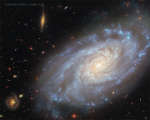
Is this what our own Milky Way Galaxy looks like from far away? Similar in size and grand design to our home Galaxy (although without the central bar), spiral galaxy NGC 3370 lies about 100 million light-years away toward the constellation of the Lion (Leo).
 APOD: 2025 December 23 Б Red Sprites and Circular Elves Lightning over Italy
22.12.2025
What's happening in the sky? Lightning. The most commonly seen type of lightning involves flashes of bright white light between clouds. Over the past 50 years, though, other types of upper-atmospheric lightning have been confirmed, including tentacled red sprites and ringed ELVES.
 APOD: 2026 August 26 Б JWST Images The Lion's Head Nebula
25.08.2026
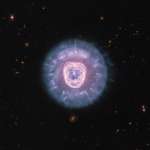
Are we looking at the future of our Sun? The James Webb Space Telescope captured todayБs composite image of the LionБs Head Nebula (NGC 2392) with its NIRCam and MIRI instruments. The LionБs Head Nebula is the remnant of a Sun-like star.
 APOD: 2025 December 24 Б Mystery: Little Red Dots in the Early Universe
23.12.2025
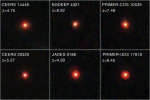
What are these little red dots (LRDs)? Nobody knows. Discovered only last year, hundreds of LRDs have now been found by the James Webb Space Telescope in the early universe. Although extremely faint, LRDs are now frequently identified in deep observations made for other purposes.
 APOD: 2026 July 17 Б The Dust Trail of Comet Tempel 2
16.07.2026
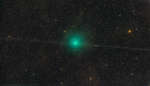
Comet 10P/Tempel 2 orbits the Sun once every 5.4 years. Currently visible in binoculars or small telescopes toward the constellation Capricornus, the periodic comet is captured in this sharp telescopic image from July 11 sporting a bright nuclear region and pretty greenish coma.
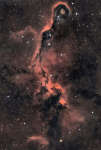 APOD: 2026 August 20 Б The Elephant s Trunk in Cepheus
19.08.2026
Like an illustration in a galactic Just So Story, the Elephant's Trunk Nebula winds through the emission region and young star cluster complex IC 1396, in the high and far off constellation of Cepheus. Also known as vdB 142, this cosmic elephant's trunk is over 20 light-years long.
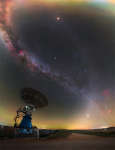 APOD: 2025 November 3 Б A Double Helix Lunar Eclipse
2.11.2025
The image was timed to capture a total lunar eclipse -- but it came with quite a twist. First, the eclipse: the fully Earth-shadowed Moon is visible as the orange orb near the top.
 APOD: 2025 October 22 Б Comet Lemmon over the High Tatras
21.10.2025
Comet Lemmon putting on a show for cameras around the globe. Passing nearest to the Earth this week, the photogenic comet C/2025 A6 (Lemmon) is now extending two long tails : a blue ion tail and a white dust tail.
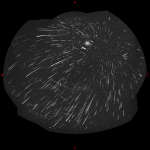 APOD: 2026 August 22 Б Mostly Perseids
21.08.2026
Recorded the night of August 12-13, images from four dedicated meteor-monitoring cameras at an astronomical observatory in Czechia were aligned and combined to create this all-night, all-sky view. On that night, the total count came to 1,706 meteors.
|
January February March April May June July August September |
|||||||||||||||||||||||||||||||||||||||||||||||||