
|
You entered: comet tail
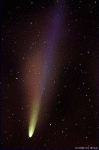 The Tails of Comet Hyakutake
2.05.1996
What makes comet tails so colorful? This photograph of Comet Hyakutake was taken the night of April 18th and highlights different components of the tail. The gold and red tail features are dust, made predominately of little bits of rock and carbon. The dust tail shines by reflecting sunlight.
 APOD: 2024 November 11 Б The Unusual Tails of Comet Tsuchinshan Atlas
11.11.2024
What created an unusual dark streak in Comet Tsuchinshan-Atlas's tail? Some images of the bright comet during mid-October not only caught its impressively long tail and its thin anti-tail, but a rather unexpected feature: a dark streak in the long tail.
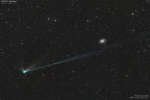 APOD: 2026 February 17 Б Tails of Comet Wierzchoе
17.02.2026
Some comets are regular guests of our solar neighborhood; others come by only once, never to return. We wonБt have another chance to see Comet C/2024 E1 (Wierzchoе), which is currently making its way through the inner Solar System. The hyperbolic orbit of this comet indicates that it will likely become an interstellar traveler.
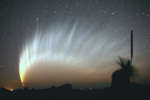 The Magnificent Tail of Comet McNaught
17.11.2013
Comet McNaught, the Great Comet of 2007, grew a spectacularly long and filamentary tail. The magnificent tail spread across the sky and was visible for several days to Southern Hemisphere observers just after sunset. The amazing tail showed its greatest extent on long-duration, wide-angle camera exposures.
 Comet G3 ATLAS: a Tail and a Telescope
24.01.2025
Comet C/2024 G3 ATLAS has made a dramatic appearance in planet Earth's skies. A visitor from the distant Oort Cloud, the comet reached its perihelion on January 13. On January 19, the bright comet was captured here from ESO Paranal Observatory in the Atacama desert in Chile.
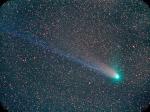 The Tails of Comet NEAT Q4
12.05.2004
Comet NEAT (Q4) is showing its tails. As the large snowball officially dubbed Comet C/2001 Q4 (NEAT) falls toward the inner Solar System, it has already passed the Earth and will reach its closest approach to the Sun this coming Saturday.
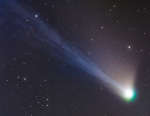 Tails of Comet Lemmon
6.05.2013
What caused the interestingly intricate tails that Comet Lemmon displayed earlier this year? First of all, just about every comet that nears the Sun displays two tails: a dust tail and an ion tail.
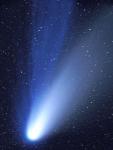 The Dust and Ion Tails of Comet Hale Bopp
27.12.2000
In 1977, Comet Hale-Bopp's intrinsic brightness exceeded any comet since 1811. Since it peaked on the other side of the Earth's orbit, however, the comet appeared only brighter than any comet in two decades. Visible above are the two tails shed by Comet Hale-Bopp.
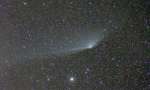 Comet PanSTARRS with Anti Tail
18.05.2013
Once the famous sunset comet, PanSTARRS (C/2011 L4) is now visible all night from much of the northern hemisphere, bound for the outer solar system as it climbs high above the ecliptic plane. Dimmer and fading, the comet's broad dust tail is still growing, though.
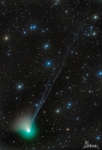 APOD: 2023 January 9 Б Tails of Comet ZTF
9.01.2023
Comet ZTF may become visible to the unaided eye. Discovered early last year, this massive snowball has been brightening as it approaches the Sun and the Earth. C/2022 E3 (ZTF) will be closest...
|
January February March April |
|||||||||||||||||||||||||||||||||||||||||||||||||