
|
You entered: deep field
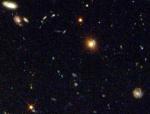 The Hubble Deep Field South
13.12.1998
Among the faintest objects are some of the most unusual objects. The Hubble Deep Field South was released after much anticipation earlier this month, delivering a unique view of some of the most distant parts of our universe. Part of this field is shown above.
 APOD: 2023 May 15 Б M16: Eagle Nebula Deep Field
14.05.2023
From afar, the whole thing looks like an eagle. A closer look at the Eagle Nebula, however, shows the bright region is actually a window into the center of a larger dark shell of dust. Through this window, a brightly-lit workshop appears where a whole open cluster of stars is being formed.
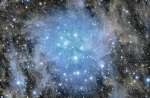 Pleiades Deep Field
21.09.2011
Have you ever seen the Pleiades star cluster? Even if you have, you probably have never seen it like this: all dusty. Perhaps the most famous star cluster on the sky, the bright stars of the Pleiades can be seen without binoculars from even the depths of a light-polluted city.
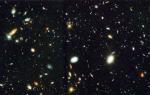 The Hubble Ultra Deep Field
8.03.2004
The above picture will be replaced later today (between 9 and 10 am EST) by the newly released Hubble Ultra Deep Field (HUDF). The HUDF is expected to be the deepest image of the universe ever taken in visible light.
 APOD: 2025 July 29 Б A Helix Nebula Deep Field
28.07.2025
Is the Helix Nebula looking at you? No, not in any biological sense, but it does look quite like an eye. The Helix Nebula is so named because it also appears that you are looking down the axis of a helix.
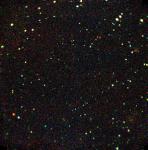 Chandra Deep Field
12.10.2002
Officially the Chandra Deep Field - South, this picture represents the deepest ever x-ray image of the Universe. One million seconds of accumulated exposure time with the orbiting Chandra X-ray Observatory went in to its making.
 Cocoon Nebula Deep Field
18.09.2018
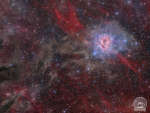
Inside the Cocoon Nebula is a newly developing cluster of stars. The cosmic Cocoon on the upper right also punctuates a long trail of obscuring interstellar dust clouds to its left. Cataloged...
 Deep Field: Nebulae of Sagittarius
20.05.2019
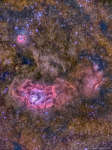
These three bright nebulae are often featured on telescopic tours of the constellation Sagittarius and the crowded starfields of the central Milky Way. In fact, 18th century cosmic tourist Charles Messier cataloged two of them; M8, the large nebula just left of center, and colorful M20 on the top left.
 An Orion Deep Field
14.01.2004
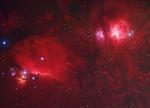
Adrift 1,500 light-years away in one of the night sky's most recognizable constellations, the glowing Orion Nebula and the dark Horsehead Nebula are contrasting cosmic vistas. They both appear in this stunning composite digital image assembled from over 20 hours of data that includes exposures filtered to record emission from hydrogen atoms.
 The Hubble Extreme Deep Field
14.10.2012
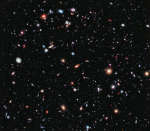
What did the first galaxies look like? To help answer this question, the Hubble Space Telescope has just finished taking the eXtreme Deep Field (XDF), the deepest image of the universe ever taken in visible light.
|
January February March April May June July August September |
|||||||||||||||||||||||||||||||||||||||||||||||||