
|
You entered: distance scale
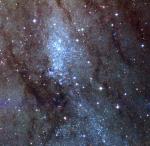 Stars of NGC 206
2.04.1999
Nestled within the dusty arms of the large spiral galaxy Andromeda (M31), the star cluster NGC 206 is one of the largest star forming regions known in our local group of galaxies. The beautiful...
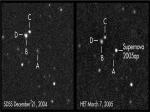 SN 2005ap: The Brightest Supernova Yet Found
16.10.2007
What could cause a bang this big? This supernova explosion was so inherently bright that it could be seen nearby 5 billion light years away (a redshift of 0.28) even with a small telescope.
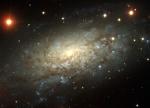 NGC 3621: Far Beyond the Local Group
5.06.2002
Far beyond the local group of galaxies lies NGC 3621, some 22 million light-years away. Found in the serpentine southern constellation Hydra, the loose spiral arms of this gorgeous island universe are loaded with luminous young star clusters and dark dust lanes.
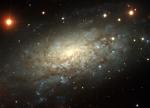 NGC 3621: Far Beyond the Local Group
19.07.2003
Far beyond the local group of galaxies lies NGC 3621, some 22 million light-years away. Found in the serpentine southern constellation Hydra, the loose spiral arms of this gorgeous island universe are loaded with luminous young star clusters and dark dust lanes.
 NGC 3621: Far Beyond the Local Group
19.09.2009
Far beyond the local group of galaxies lies NGC 3621, some 22 million light-years away. Found in the multi-headed southern constellation Hydra, the winding spiral arms of this gorgeous island universe are loaded with luminous young star clusters and dark dust lanes.
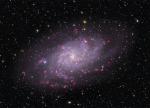 M33: Spiral Galaxy in Triangulum
14.09.2006
The small, northern constellation Triangulum harbors this magnificent face-on spiral galaxy, M33. Its popular names include the Pinwheel Galaxy or just the Triangulum Galaxy. M33 is over 50,000 light-years in diameter, third largest in the Local Group of galaxies after the Andromeda Galaxy (M31), and our own Milky Way.
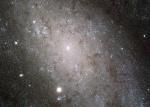 The Stars of NGC 300
16.04.2004
Like grains of sand on a cosmic beach, individual stars of large spiral galaxy NGC 300 are resolved in this sharp image from the Hubble Space Telescope's Advanced Camera for Surveys (ACS).
 Gamma Ray Bursts from the Unknown
22.11.1996
Gamma Ray Bursts (GRBs) pose one of the greatest mysteries of modern astronomy. About once a day, the gamma-ray sky lights up with a spectacular explosion. No one knows what causes these explosions or even how far away they are.
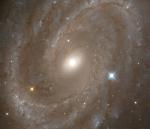 NGC 4603 and the Expanding Universe
27.05.1999
NGC 4603, a galaxy with majestic spiral arms and intricate dust lanes, is 108 million light-years away. Its distance has been accurately measured by astronomers using one of the fundamental yardsticks of the extragalactic distance scale - pulsating variable stars known as Cepheids.
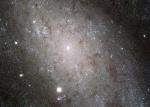 The Stars of NGC 300
20.08.2005
Like grains of sand on a cosmic beach, individual stars of large spiral galaxy NGC 300 are resolved in this sharp image from the Hubble Space Telescope's Advanced Camera for Surveys (ACS). The inner region of the galaxy is pictured, spanning about 7,500 light-years.
|
January February March April May June July August September October |
|||||||||||||||||||||||||||||||||||||||||||||||||