
|
You entered: explorer 1
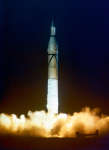 The First Explorer
31.01.2018
Sixty years ago, on January 31, 1958, the First Explorer was successfully launched by the Army Ballistic Missile Agency on a Jupiter-C rocket. Inaugurating the era of space exploration for the United States, Explorer...
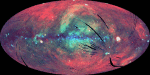 ROSAT Explores The X-Ray Sky
8.10.1996
Launched in 1990, the orbiting ROSAT observatory explored the Universe by viewing the entire sky in x-rays - photons with about 1,000 times more energy than visible light. This ROSAT survey produced the sharpest, most sensitive image of the x-ray sky to date.
 ROSAT Explores The X-Ray Sky
19.08.2000
Launched in 1990, the orbiting ROSAT observatory explored the Universe by viewing the entire sky in x-rays -- photons with about 1,000 times more energy than visible light. This ROSAT survey produced the sharpest, most sensitive image of the x-ray sky to date.
 Young Stars, Stellar Jets
28.07.2023
High-speed outflows of molecular gas from a pair of actively forming young stars shine in infrared light, revealing themselves in this NIRcam image from the James Webb Space Telescope. Cataloged as HH (Herbig-Haro) 46/47, the young stars are lodged within a dark nebula that is largely opaque when viewed in visible light.
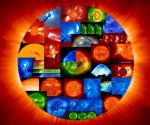 SOHO s Uninterrupted View of the Sun
1.12.2005
Launched ten years ago this week, SOHO (the SOlar and Heliospheric Observatory) still enjoys an uninterrupted view of the Sun. Twelve sungazing instruments on board the spacecraft have explored the Sun's internal structure...
 InSight's Final Selfie
4.11.2022
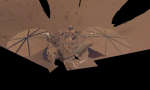
The Mars InSight lander returned its first image from the Red Planet's flat, equatorial Elysium Planitia after a successful touchdown on November 26, 2018. The history making mission to explore the martian Interior using Seismic investigations, geodesy, and heat transport has been operating for over 1,400 martian days or sols.
 Young Star, Dark Cloud
26.12.2003
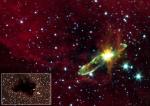
High-speed outflows of molecular gas from a young stellar object glow in infrared light, revealing themselves in this recent false-color image from the Spitzer Space Telescope. Cataloged as HH (Herbig-Haro) 46/47 the infrared source...
 Cometary Knots in the Helix Nebula
16.04.1996
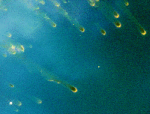
Four hundred fifty light-years from Earth, the wind from a dying, sun-like star produced a planetary nebula popularly known as the Helix. While exploring the Helix's gaseous envelope with the Hubble Space Telescope (HST), astronomers discovered indications of 1,000s of striking "cometary knots" like those shown above.
 APOD: 2004 August 27- The Sedna Scenario
27.08.2004
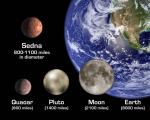
The discovery of Sedna (aka 2003 VB12), the most distant known object orbiting the Sun, presents a mystery. Pluto's orbit averages about 40 AU in radius, where an AU (Astronomical Unit) is the Earth-Sun distance.
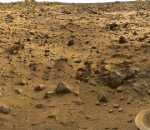 20 Years Ago: Vikings on Mars
20.07.1996
On July 20, 1976, NASA's Viking 1 lander become the first spacecraft to land on Mars, followed weeks later by its twin robot explorer, the Viking 2 lander. Operating on the Martian surface...
|
January February March April May June July August September October |
|||||||||||||||||||||||||||||||||||||||||||||||||