
|
You entered: galaxy pair
 M51 in 255 Hours
11.08.2023
An intriguing pair of interacting galaxies, M51 is the 51st entry in Charles Messier's famous catalog. Perhaps the original spiral nebula, the large galaxy with whirlpool-like spiral structure seen nearly face-on is also cataloged as NGC 5194. Its spiral arms and dust lanes sweep in front of a companion galaxy (right), NGC 5195.
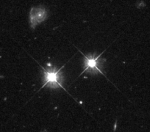 A Milestone Quasar
18.08.1996
Here is a rather typical quasar. But since quasars are so unusual it is quite atypical of most familiar objects. Of the two bright objects in the center of this photo, the quasar is on the left.
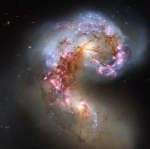 The Antennae Galaxies in Collision
3.12.2020
Sixty million light-years away toward the southerly constellation Corvus, these two large galaxies are colliding. The cosmic train wreck captured in stunning detail in this Hubble Space Telescope snapshot takes hundreds of millions of years to play out. Cataloged as NGC 4038 and NGC 4039, the galaxies' individual stars don't often collide though.
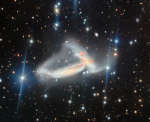 APOD: 2026 September 4 Б Na Uhane Mahoe Huki Pu i ke Ola
4.09.2026
Nд йUhane Mдhoe Huki Pе i ke Ola, is the Hawaiian name given to this image of a pair of spiral galaxies locked in a mutual gravitational embrace. Some 200 million light-years distant toward...
 M51: Tidal Streams and H-alpha Ciffs
13.12.2024
An intriguing pair of interacting galaxies, M51 is the 51st entry in Charles Messier's famous catalog. Perhaps the original spiral nebula, the large galaxy with whirlpool-like spiral structure seen nearly face-on is also cataloged as NGC 5194. Its spiral arms and dust lanes sweep in front of its smaller companion galaxy, NGC 5195.
 APOD: 2024 February 7 Б The Heart Shaped Antennae Galaxies
7.02.2024
Are these two galaxies really attracted to each other? Yes, gravitationally, and the result appears as an enormous iconic heart -- at least for now. Pictured is the pair of galaxies cataloged as NGC 4038 and NGC 4039,known as the Antennae Galaxies.
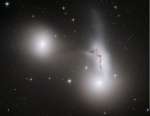 Hickson Compact Group 90
13.03.2009
Scanning the skies for galaxies, Canadian astronomer Paul Hickson and colleagues identified some 100 compact groups of galaxies, now appropriately called Hickson Compact Groups (HCGs). This sharp Hubble image shows one such galaxy group, HCG 90, in startling detail.
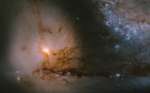 NGC 5195: The Dot under the Question Mark
31.08.2013
Dwarf galaxy NGC 5195 is best known as the smaller companion of spiral M51, the Whirlpool galaxy. Seen together they seem to trace the curve and dot of a cosmic question mark, recorded in Lord Rosse's 19th century drawings as one of the original spiral nebulae.
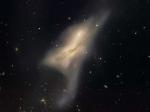 The Colliding Galaxies of NGC 520
12.09.2005
Is this one galaxy or two? The jumble of stars, gas, and dust that is NGC 520 is now thought to incorporate the remains of two separate galaxies. A combination of observations and simulations indicate the NGC 520 is actually the collision of two disk galaxies.
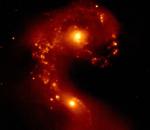 Antennae Galaxies in Near Infrared
11.04.2002
What happens when galaxies collide? One of the best studied examples of the jumble of star clusters, gas, and dust clouds produced by such a cosmic train wreck is the interacting galaxy pair NGC 4038 / NGC 4039, the Antennae Galaxies, only sixty million light-years away.
|
January February March April May June July August September |
|||||||||||||||||||||||||||||||||||||||||||||||||