
|
You entered: pulsar
 The Pulsar Powered Crab
31.05.1996
In the Summer of 1054 A.D. Chinese astronomers reported that a star in the constellation of Taurus suddenly became as bright as the full Moon. Fading slowly, it remained visible for over a year.
 APOD: 2025 December 29 Б M1: The Crab Nebula
29.12.2025
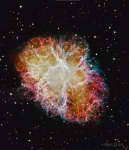
This is the mess that is left when a star explodes. The Crab Nebula, the result of a supernova seen in 1054 AD, is filled with mysterious filaments. The filaments are not only tremendously...
 The Long Jet of the Lighthouse Nebula
21.02.2014
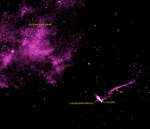
The Lighthouse nebula was formed by the wind of a pulsar, a rapidly rotating, magnetized neutron star, as it speeds through the interstellar medium at over 1,000 kilometers per second. Some...
 Gamma Ray Crab, Geminga
24.06.1995
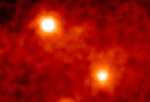
What if you could "see" in gamma-rays? If you could, these two spinning neutron stars or pulsars would be among the brightest objects in the sky. This computer processed image shows the Crab Nebula pulsar (below and right of center) and the Geminga pulsar (above and left of center) in the "light" of gamma-rays.
 M1: The Exploding Crab Nebula
22.11.1995
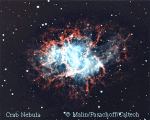
The Crab Nebula resulted from a star that exploded - a supernova. The outer layers of the star were thrown violently into space, while the inner core collapsed to form a neutron star. This neutron...
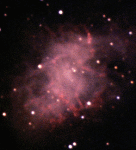 M1: The Crab Nebula
25.07.1995
In the year 1054 a star in the constellation of Taurus exploded in a spectacular supernova so bright it appeared to dominate the sky except for the Sun and Moon for many days. It left behind one of the most brilliant nebulae, listed first in Charles Messier's list of nebulous sky objects.
 Supernova Remnant CTA 1
23.08.2024
There is a quiet pulsar at the heart of CTA 1. The supernova remnant was discovered as a source of emission at radio wavelengths by astronomers in 1960 and since identified as the result of the death explosion of a massive star.
 Composite Crab
4.09.2003
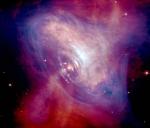
The Crab Pulsar, a city-sized, magnetized neutron star spinning 30 times a second, lies at the center of this composite image of the inner region of the well-known Crab Nebula. The spectacular picture combines...
 Composite Crab
26.03.2005
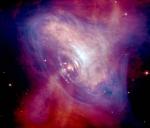
(xxxre linkxxx) The Crab Pulsar, a city-sized, magnetized neutron star spinning 30 times a second, lies at the center of this composite image of the inner region of the well-known Crab Nebula. The spectacular...
 The High Energy Crab Nebula
9.09.1996
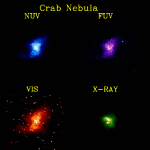
This is the mess that is left when a star explodes. The Crab Nebula is so energetic that it glows in every kind of light known. Shown above are images of the Crab Nebula from visible light to the X-ray band.
|
January February March April May June July August September |
|||||||||||||||||||||||||||||||||||||||||||||||||