
|
You entered: red giant
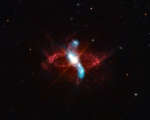 Symbiotic R Aquarii
29.06.2017
A long recognized naked-eye variable star, R Aquarii is actually an interacting binary star system, two stars that seem to have a close, symbiotic relationship. About 710 light years away, it consists of a cool red giant star and hot, dense white dwarf star in mutual orbit around their common center of mass.
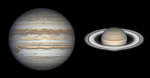 The Giants of Summer
29.07.2020
As Comet NEOWISE sweeps through northern summer skies, Jupiter and Saturn are shining brightly, near opposition. With Jupiter opposite the Sun on July 14 and Saturn on July 21, the giant planets are still near their closest to planet Earth in 2020.
 Blue Stragglers In NGC 6397
22.06.2000
In our neck of the Galaxy stars are too far apart to be in danger of colliding, but in the dense cores of globular star clusters star collisions may be relatively common. In fact...
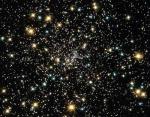 Blue Stragglers in NGC 6397
8.08.2003
In our neck of the Galaxy stars are too far apart to be in danger of colliding, but in the dense cores of globular star clusters star collisions may be relatively common. In fact...
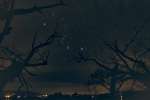 The Hunter s Stars
19.01.2012
Begirt with many a blazing star, Orion, the Hunter, is one of the most easily recognizable constellations. In this night skyscape from January 15, the hunter's stars rise in the northern hemisphere...
 Mira: The Wonderful Star
22.07.2006
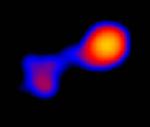
To seventeenth century astronomers, Omicron Ceti or Mira was known as a wonderful star - a star whose brightness could change dramatically in the course of about 11 months. Modern astronomers now recognize an entire class of long period Mira-type variables as cool, pulsating, red giant stars, 700 or so times the diameter of the Sun.
 Symbiotic R Aquarii
11.07.2018
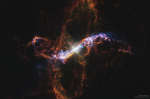
You can see it change in brightness with just binoculars over the course of a year. Variable star R Aquarii is actually an interacting binary star system, two stars that seem to have a close, symbiotic relationship.
 Explosions from White Dwarf Star RS Oph
26.07.2006
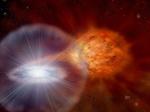
Spectacular explosions keep occurring in the binary star system named RS Ophiuchi. Every 20 years or so, the red giant star dumps enough hydrogen gas onto its companion white dwarf star to set off a brilliant thermonuclear explosion on the white dwarf's surface.
 Emerging Planetary Nebula CRL 618
6.09.2000
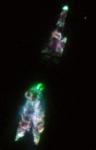
CRL 618 may look to some like an Olympian declaring victory. Only a few hundred years ago, however, CRL 618 appeared as a relatively modest red giant star. Since then it has run out of core material to fuse and so has started to become a planetary nebula.
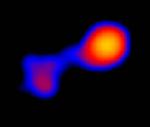 Mira: The Wonderful Star
5.05.2005
To seventeenth century astronomers, Omicron Ceti or Mira was known as a wonderful star - a star whose brightness could change dramatically in the course of about 11 months. Modern astronomers now recognize an entire class of long period Mira-type variables as cool, pulsating, red giant stars, 700 or so times the diameter of the Sun.
|
January February March April May June July August September October |
|||||||||||||||||||||||||||||||||||||||||||||||||