
|
You entered: Earth orbit
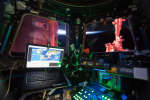 Interior View
22.01.2015
Some prefer windows, and these are the best available on board the International Space Station. Taken on January 4, this snapshot from inside the station's large, seven-window Cupola module also shows off a workstation for controlling Canadarm2.
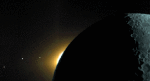 The Ecliptic Plane
29.05.1999
The Plane of the Ecliptic is illustrated in this Clementine star tracker camera image which reveals (from right to left) the Moon lit by Earthshine, the Sun's corona rising over the Moon's dark limb, and the planets Saturn, Mars, and Mercury.
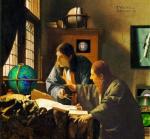 APOD Is Ten Years Old Today
16.06.2005
Welcome to the eleventh year of Astronomy Picture of the Day! In a decade of editing the APOD web pages, the industrious Robert Nemiroff (left) and persistent Jerry Bonnell (right) have enjoyed exploring compelling...
 Lunation
29.08.2004
Our Moon's appearance changes nightly. This time-lapse sequence shows what our Moon looks like during a lunation, a complete lunar cycle. As the Moon orbits the Earth, the half illuminated by the Sun first becomes increasingly visible, then decreasingly visible. The Moon always keeps the same face toward the Earth.
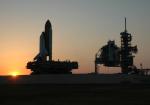 Discovery in Motion
8.07.2006
On July 4th, the space shuttle orbiter Discovery rocketed into space on mission STS-121. Now docked with the International Space Station, Discovery orbits planet Earth at about 27 thousand kilometers per hour.
 Lunation
10.08.2003
Our Moon's appearance changes nightly. This time-lapse sequence shows what our Moon looks like during a lunation, a complete lunar cycle. As the Moon orbits the Earth, the half illuminated by the Sun first becomes increasingly visible, then decreasingly visible. The Moon always keeps the same face toward the Earth.
 Lunation
13.11.2005
Our Moon's appearance changes nightly. This time-lapse sequence shows what our Moon looks like during a lunation, a complete lunar cycle. As the Moon orbits the Earth, the half illuminated by the Sun first becomes increasingly visible, then decreasingly visible. The Moon always keeps the same face toward the Earth.
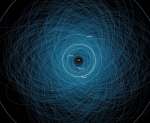 Orbits of Potentially Hazardous Asteroids
12.08.2013
Are asteroids dangerous? Some are, but the likelihood of a dangerous asteroid striking the Earth during any given year is low. Because some past mass extinction events have been linked to asteroid impacts, however, humanity has made it a priority to find and catalog those asteroids that may one day affect life on Earth.
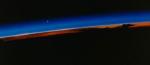 Venus On The Horizon
14.10.1997
The month of October features a sky full of planets, including Venus as the brilliant evening star. Besides the sun and moon, Venus is the brightest object visible in Earth's sky. This month, Venus appears in early evening near the red planet Mars and Mars' red giant rival Antares above the southwestern horizon.
 APOD: 2025 June 14 Б Meteors and Satellite Trails over the Limay River
14.06.2025
What are all those streaks in the sky? A galaxy, many satellite trails, and a few meteors. First, far in the distance, the majestic band of our Milky Way Galaxy runs down the left. Mirroring it on the right are several parallel trails of Earth-orbiting Starlink satellites. Many fainter satellite trails also crisscross the image.
|
January February March April May June July August September October |
|||||||||||||||||||||||||||||||||||||||||||||||||