
|
You entered: Saturn's Moon
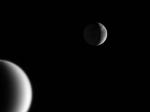 Crescents of Titan and Dione
29.03.2005
What would it be like to see a sky with many moons? Such is the sky above Saturn. When appearing close to each other, moons will show a similar phase. A view with...
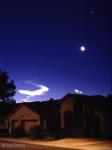 Moon, Planets, and Rocket Trails
14.07.1999
Are you an early riser? Over the last month or so, the bright planets Jupiter and Saturn have come to adorn eastern skies before sunrise. In fact, astrophotographer Joe Orman anticipated that an early...
 Carl Sagan 1934-1996
26.12.1996
Carl Sagan died last Friday at the age of 62. Sagan was the world's most famous astronomer. Among his many activities as a scientist, he contributed to the discovery that the atmosphere...
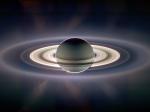 In the Shadow of Saturn
16.10.2006
In the shadow of Saturn, unexpected wonders appear. The robotic Cassini spacecraft now orbiting Saturn recently drifted in giant planet's shadow for about 12 hours and looked back toward the eclipsed Sun. Cassini saw a view unlike any other.
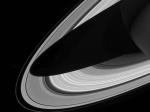 A Shadow on the Rings of Saturn
21.07.2004
This picture of Saturn could not have been taken from Earth. No Earth based picture could possibly view the night side of Saturn and the corresponding shadow cast across Saturn's rings. Since Earth is much closer to the Sun than Saturn, only the day side of the planet is visible from the Earth.
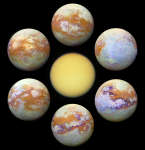 Seeing Titan
31.03.2023
Shrouded in a thick atmosphere, Saturn's largest moon Titan really is hard to see. Small particles suspended in the upper atmosphere cause an almost impenetrable haze, strongly scattering light at visible wavelengths and hiding Titan's surface features from prying eyes.
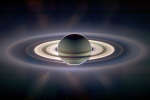 In the Shadow of Saturn
11.01.2009
In the shadow of Saturn, unexpected wonders appear. The robotic Cassini spacecraft now orbiting Saturn recently drifted in giant planet's shadow for about 12 hours and looked back toward the eclipsed Sun. Cassini saw a view unlike any other.
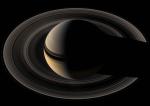 Crescent Saturn
23.10.2007
Saturn never shows a crescent phase -- from Earth. But when viewed from beyond, the majestic giant planet can show an unfamiliar diminutive sliver. This image of crescent Saturn in natural color was taken by the robotic Cassini spacecraft in May.
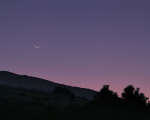 Friday the Moon Smiled
18.11.2017
Friday, an old Moon smiled for early morning risers. Its waning sunlit crescent is captured in this atmospheric scene from clear skies near Bursa, Turkey, planet Earth. In the subtle twilight hues nearby celestial lights are Jupiter (top) and Venus shining close to the eastern horizon.
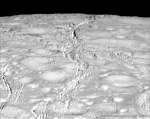 The Fractured North Pole of Saturns Enceladus
21.10.2015
The north pole of Saturn's moon Enceladus is unexpectedly fascinating and complex. Previous to the latest flyby of the robotic Cassini spacecraft, the northern region was known mostly for its unusually high abundance of craters.
|
January February March April May June July August September October |
|||||||||||||||||||||||||||||||||||||||||||||||||