
|
You entered: Saturn rings
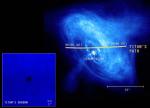 Titan s X Ray
29.04.2004
This June's rare and much heralded transit of Venus will feature our currently brilliant evening star in silhouette, as the inner planet glides across the face of the Sun. But on January 5, 2003 and even rarer transit took place.
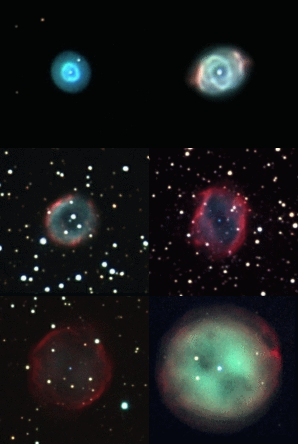 The Planetary Nebula Show
3.10.2001
What do the Owl, the Cat's Eye, the Ghost of Jupiter, and Saturn have in common? They're all planetary nebulae of course(!), glowing gaseous shrouds shed by dying sun-like stars as they run out of nuclear fuel.
 The Planetary Nebula Show
14.06.2003
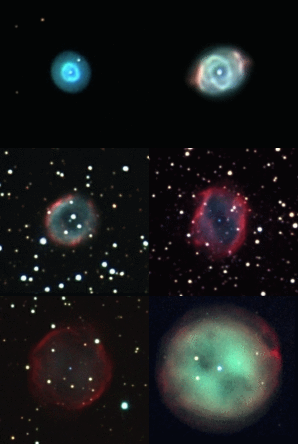
What do the Owl, the Cat's Eye, the Ghost of Jupiter, and Saturn have in common? They're all planetary nebulae of course, glowing gaseous shrouds shed by dying sun-like stars as they run out of nuclear fuel.
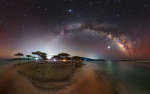 Light and Glory over Crete
16.11.2020
The month was July, the place was the Greek island of Crete, and the sky was spectacular. Of course there were the usual stars like Polaris, Vega, and Antares -- and that common asterism everyone knows: the Big Dipper. But this sky was just getting started.
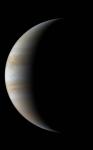 Farewell Jupiter
8.08.2001
Next stop: Saturn. The Cassini spacecraft, launched from Earth four years ago, has now swung past Jupiter and should arrive at Saturn in the year 2004. Pictured to the left is a parting shot from Cassini in January that would not have been possible from Earth: Jupiter showing a crescent phase.
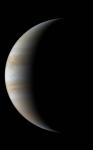 Farewell Jupiter
8.08.2001
Next stop: Saturn. The Cassini spacecraft, launched from Earth four years ago, has now swung past Jupiter and should arrive at Saturn in the year 2004. Pictured to the left is a parting shot from Cassini in January that would not have been possible from Earth: Jupiter showing a crescent phase.
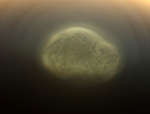 South Polar Vortex Discovered on Titan
24.07.2012
What's happening over the south pole of Titan? A vortex of haze appears to be forming, although no one is sure why. The above natural-color image shows the light-colored feature. The vortex was found on images taken last month when the robotic Cassini spacecraft flew by the unusual atmosphere-shrouded moon of Saturn.
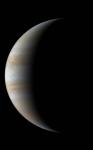 Farewell Jupiter
9.03.2003
Next stop: Saturn. The Cassini spacecraft, launched from Earth in 1997, has now swung past Jupiter and should arrive at Saturn in the year 2004. Pictured to the left is a parting shot from Cassini in January that would not have been possible from Earth: Jupiter showing a crescent phase.
 Saturn in the Milky Way
10.06.2017
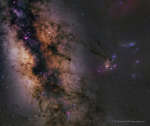
Saturn is near opposition in planet Earth's sky. Rising at sunset and shining brightly throughout the night, it also lies near a line-of-sight to crowded starfields, nebulae, and obscuring dust clouds along the Milky Way.
 The Moon s Saturn
26.05.2007
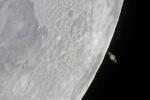
On May 22nd, just days after sharing the western evening sky with Venus, the Moon moved on to Saturn - actually passing in front of the ringed planet when viewed in skies over Europe, northern Africa, and western Asia.
|
January February March April May June July August September October |
|||||||||||||||||||||||||||||||||||||||||||||||||