
|
You entered: black hole
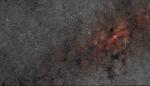 The Galactic Center in Infrared
21.06.1999
The center of our Galaxy is a busy place. In visible light, much of the Galactic Center is obscured by opaque dust. In infrared light, however, dust glows more and obscures less, allowing nearly one million stars to be recorded in the above photograph.
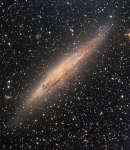 Nearby Spiral Galaxy NGC 4945
26.02.2022
Large spiral galaxy NGC 4945 is seen nearly edge-on in this cosmic galaxy close-up. It's almost the size of our Milky Way Galaxy. NGC 4945's own dusty disk, young blue star clusters, and pink star forming regions stand out in the colorful telescopic frame.
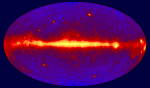 The Gamma Ray Sky
22.02.1997
What if you could "see" gamma rays? If you could, the sky would seem to be filled with a shimmering high-energy glow from the most exotic and mysterious objects in the Universe.
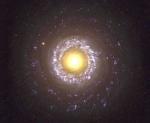 Spiral Galaxy NGC 7742
26.07.2003
This might resemble a fried egg you've had for breakfast, but it's actually much larger. In fact, ringed by blue-tinted star forming regions and faintly visible spiral arms, the yolk-yellow center of this face-on spiral galaxy, NGC 7742, is about 3,000 light-years across.
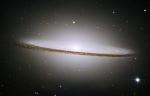 The Sombrero Galaxy from HST
15.01.2006
Why does the Sombrero Galaxy look like a hat? Reasons include the Sombrero's unusually large and extended central bulge of stars, and dark prominent dust lanes that appear in a disk that we see nearly edge-on. Billions of old stars cause the diffuse glow of the extended central bulge.
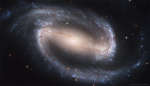 APOD: 2026 May 17 Б NGC 1300: Barred Spiral Galaxy
17.05.2026
Across the center of this spiral galaxy is a bar. And at the center of this bar is smaller spiral. And at the center of that spiral is a supermassive black hole. This...
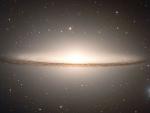 The Sombrero Galaxy from VLT
21.10.2001
Why does the Sombrero Galaxy look like a hat? Reasons include the Sombrero's unusually large and extended central bulge of stars, and dark prominent dust lanes that appear in a disk that we see nearly edge-on. Billions of old stars cause the diffuse glow of the extended central bulge.
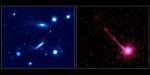 PKS 1127 145: Quasar View
8.02.2002
The quasar known as PKS 1127-145 lies ten billion light-years from our fair planet. A Hubble Space Telescope view in the left panel shows this quasar along with other galaxies as they appear in optical light. The quasar itself is the brightest object in the lower right corner.
 Messier 66 Close Up
28.01.2021
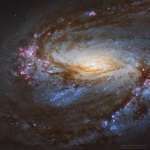
Big, beautiful spiral galaxy Messier 66 lies a mere 35 million light-years away. The gorgeous island universe is about 100 thousand light-years across, similar in size to the Milky Way. This reprocessed Hubble Space Telescope close-up view spans a region about 30,000 light-years wide around the galactic core.
 Seyfert Galaxy NGC 7742
23.10.1998
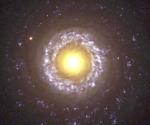
This might resemble a fried egg you've had for breakfast, but it's actually much larger. In fact, ringed by blue-tinted star forming regions and faintly visible spiral arms, the yolk-yellow center of this face-on spiral galaxy, NGC 7742, is about 3,000 light-years across.
|
January February March April May June July August September October |
|||||||||||||||||||||||||||||||||||||||||||||||||