
|
You entered: cluster
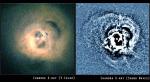 A Note on the Perseus Cluster
12.09.2003
A truly enormous collection of thousands of galaxies, the Perseus Cluster - like other large galaxy clusters - is filled with hot, x-ray emitting gas. The x-ray hot gas (not the individual galaxies) appears in the left panel above, a false color image from the Chandra Observatory.
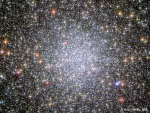 Globular Star Cluster 47 Tuc
19.05.2015
Globular star cluster 47 Tucanae is a jewel box of the southern sky. Also known as NGC 104, it roams the halo of our Milky Way Galaxy along with over 150 other globular star clusters.
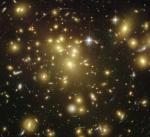 Galaxy Cluster Abell 1689 Warps Space
27.06.2004
Two billion light-years away, galaxy cluster Abell 1689 is one of the most massive objects in the Universe. In this view from the Hubble Space Telescope's Advanced Camera for Surveys, Abell 1689...
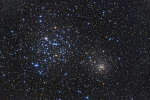 Open Star Clusters M35 and NGC 2158
3.01.2013
Open clusters of stars can be near or far, young or old, and diffuse or compact. Found near the plane of our Milky Way galaxy, they contain from 100 to 10,000 stars, all of which formed at nearly the same time. Bright blue stars frequently distinguish younger open clusters.
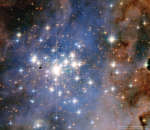 Young Star Cluster Trumpler 14 from Hubble
14.05.2019
Why does star cluster Trumpler 14 have so many bright stars? Because it is so young. Many cluster stars have formed only in the past 5 million years and are so hot they emit detectable X-rays.
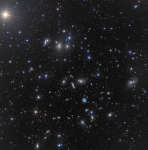 The Hercules Cluster of Galaxies
25.06.2014
These are galaxies of the Hercules Cluster, an archipelago of island universes a mere 500 million light-years away. Also known as Abell 2151, this cluster is loaded with gas and dust rich, star-forming spiral galaxies but has relatively few elliptical galaxies, which lack gas and dust and the associated newborn stars.
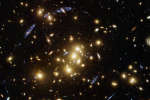 Giant Cluster Bends, Breaks Images
23.08.2009
What are those strange blue objects? Many of the brightest blue images are of a single, unusual, beaded, blue, ring-like galaxy which just happens to line-up behind a giant cluster of galaxies. Cluster galaxies here typically appear yellow and -- together with the cluster's dark matter -- act as a gravitational lens.
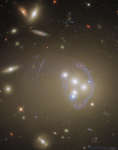 Abell 3827: Cannibal Cluster Gravitational Lens
23.08.2021
Is that one galaxy or three? Toward the right of the featured Hubble image of the massive galaxy cluster Abell 3827 is what appears to be a most unusual galaxy -- curved and with three centers.
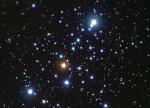 Distant Open Cluster M103
7.02.2001
Bright blue stars highlight the open cluster known as M103. The gas clouds from which these stars condensed has long dispersed. Of the stars that were formed, the brightest, bluest, and most massive have already used up their nuclear fuel and self-destructed in supernova explosions.
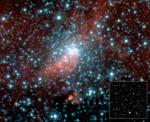 Glimpse of a Globular Star Cluster
14.10.2004
Not a glimpse of this cluster of stars can be seen in the inset visible light image (lower right). Still, the infrared view from the Spitzer Space Telescope reveals a massive globular star cluster of about 300,000 suns in an apparently empty region of sky in the constellation Aquila.
|
January February March April May June July August September October |
|||||||||||||||||||||||||||||||||||||||||||||||||