
|
You entered: cluster gas
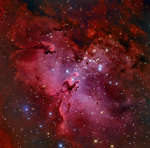 M16 and the Eagle Nebula
7.06.2014
A star cluster around 2 million years young, M16 is surrounded by natal clouds of dust and glowing gas also known as The Eagle Nebula. This beautifully detailed image of the region includes cosmic sculptures made famous in Hubble Space Telescope close-ups of the starforming complex.
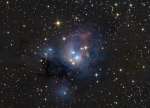 Young Suns of NGC 7129
27.10.2011
Young suns still lie within dusty NGC 7129, some 3,000 light-years away toward the royal constellation Cepheus. While these stars are at a relatively tender age, only a few million years old, it is likely that our own Sun formed in a similar stellar nursery some five billion years ago.
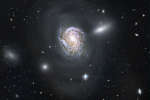 NGC 4911: Spiral Diving into a Dense Cluster
8.09.2010
Why are there faint rings around this spiral galaxy? Possibly because the galaxy, NGC 4911, is being pulled at by its neighbors as it falls into the enormous Coma Cluster of Galaxies.
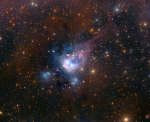 Young Suns of NGC 7129
29.08.2016
Young suns still lie within dusty NGC 7129, some 3,000 light-years away toward the royal constellation Cepheus. While these stars are at a relatively tender age, only a few million years old, it is likely that our own Sun formed in a similar stellar nursery some five billion years ago.
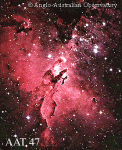 M16: Dust and an Open Cluster
1.11.1995
The photogenic M16 shown above is composed of a young star cluster and a spectacular emission nebulae lined with distinct regions of interstellar dust. Most of the stars in the cluster can be seen offset just above and to the right of the photograph's center.
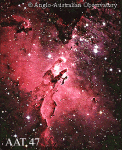 M16: Nebula With Star Cluster
18.01.1997
The photogenic M16 shown above is composed of a young star cluster associated with a spectacular emission nebulae lined with clouds of interstellar dust. The gorgeous spectacle lies toward the galactic center region, some 7,000 light years distant in the constellation Serpens.
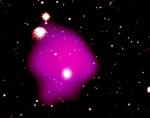 Hot Gas and Dark Matter
4.04.1999
Is the gravity of the galaxies seen in this image high enough to contain the glowing hot gas? Superposed on an optical picture of a group of galaxies is an image taken in X-ray light.
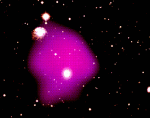 Hot Gas and Dark Matter
2.09.1995
Is the gravity of the above galaxies high enough to contain the glowing hot gas? Superposed on an optical picture of a group of galaxies is an image taken in X-ray light. The X-ray...
 In the Center of the Trapezium
18.11.1997
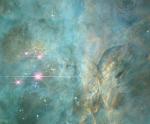
Start with the constellation of Orion. Below Orion's belt is a fuzzy area known as the Great Nebula of Orion or M42. In this nebula is a bright star cluster known as the Trapezium, shown above. New stellar systems are forming there in gigantic globs of gas and dust known as Proplyds.
 In the Center of the Trapezium
2.03.2003
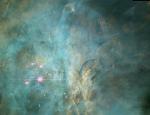
Start with the constellation of Orion. Near Orion's belt is a fuzzy area known as the Great Nebula of Orion or M42. In this nebula is a bright star cluster known as the Trapezium, shown above. New stellar systems are forming there in gigantic globs of gas and dust known as Proplyds.
|
January February March April May June July August |
||||||||||||||||||||||||||||||||||||||||||||||||||||||||