
|
You entered: early universe
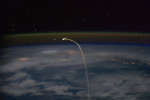 Shuttle Reentry Streak from Orbit
1.08.2011
What's that strange bright streak? It is the last image ever of a space shuttle from orbit. A week and a half ago, after decoupling from the International Space Station, the Space Shuttle Atlantis fired its rockets for the last time, lost its orbital speed, and plummeted back to Earth.
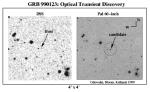 Galaxy And Gamma Ray Burst
24.01.1999
Gamma-ray bursts rule the high-energy sky and Saturday another brief, intense flash of gamma-rays from the cosmos triggered space-based detectors. The orbiting Compton Observatory's BATSE instrument quickly relayed the burst's approximate location to fast-slewing, ground-based cameras primed to search for an elusive optical flash.
 APOD: 2024 July 1 Б Time Spiral
30.06.2024
What's happened since the universe started? The time spiral shown here features a few notable highlights. At the spiral's center is the Big Bang, the place where time, as we know it, began about 13.8 billion years ago.
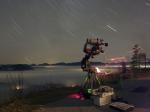 A Window to the Once Secret Sky
13.04.2005
If there was a window nearby to the distant universe -- would you look through it? Quite possibly, there is, in the form of a small telescope. A local skykeeper could be a relative or a stranger and is frequently proud to show off the sky free of charge.
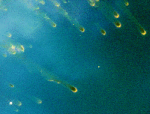 Cometary Knots in the Helix Nebula
16.04.1996
Four hundred fifty light-years from Earth, the wind from a dying, sun-like star produced a planetary nebula popularly known as the Helix. While exploring the Helix's gaseous envelope with the Hubble Space Telescope (HST), astronomers discovered indications of 1,000s of striking "cometary knots" like those shown above.
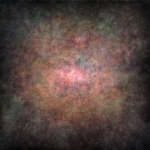 Median Mashup: Hubble s Top 100
13.09.2014
Now, as you sip your cosmic latte you can view 100 Hubble Space Telescope images at the same time. The popular scenes of the cosmos as captured from low Earth orbit are all combined into this single digital presentation. To make it, Hubble's top 100 images were downloaded and resized to identical pixel dimensions.
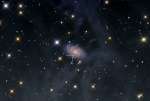 Art and Science in NGC 981
11.11.2009
This beautiful telescopic skyscape features spiral galaxy NGC 981. The island universe is about 50,000 light-years across and lies some 60 million light-years away toward the constellation Aries. An artistic presentation, the image...
 NGC 7331 and Beyond
13.09.2023
Big, beautiful spiral galaxy NGC 7331 is often touted as an analog to our own Milky Way. About 50 million light-years distant in the northern constellation Pegasus, NGC 7331 was recognized early on as a spiral nebula and is actually one of the brighter galaxies not included in Charles Messier's famous 18th century catalog.
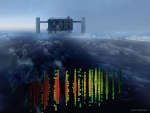 Distant Neutrinos Detected Below Antarctic Ice
31.08.2015
From where do these neutrinos come? The IceCube Neutrino Observatory near the South Pole of the Earth has begun to detect nearly invisible particles of very high energy. Although these rarely-interacting neutrinos pass through much of the Earth just before being detected, where they started remains a mystery.
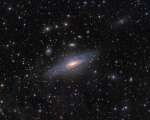 NGC 7331 and Beyond
12.08.2011
Big, beautiful spiral galaxy NGC 7331 is often touted as an analog to our own Milky Way. About 50 million light-years distant in the northern constellation Pegasus, NGC 7331 was recognized early on as a spiral nebula and is actually one of the brighter galaxies not included in Charles Messier's famous 18th century catalog.
|
January February March April May June July August September |
|||||||||||||||||||||||||||||||||||||||||||||||||