
|
You entered: full moon
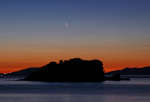 Venus and Jupiter at Dawn
21.08.2014
On Monday morning, Venus and Jupiter gathered close in dawn skies, for some separated by about half the width of a full moon. It was their closest conjunction since 2000, captured here above the eastern horizon before sunrise.
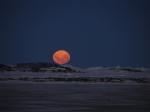 Moon Over Antarctica
25.11.2005
Last week, the nearly Full Moon set along the northern horizion - as seen from Davis Station, Antarctica. The squashed orange pumpkin shape just silhouettes the peak of a distant iceberg in this stunning view.
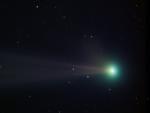 Colors of Comet Pojmanski
11.03.2006
Comet Pojmanski flew by planet Earth last weekend on a surprise trip through the inner solar system. Then an easy binocular target for morning skygazers, Pojmanski ultimately showed off a long tail, but it also presented some lovely green-blue hues as gas molecules in its tenuous coma and tail fluoresced in the sunlight.
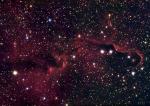 The Elephant s Trunk in IC 1396
20.07.2001
Like a picture from a galactic Just So Story, the Elephant's Trunk Nebula winds through the emission nebula and young star cluster complex IC 1396, in the high and far off constellation of Cepheus. Bright swept-back ridges compose the suggestive form, outlining pockets of interstellar dust and gas.
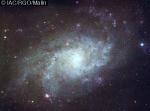 Nearby Spiral M33
21.07.1998
M33 is a prominent nearby spiral galaxy. Nicknamed the Triangulum, M33 is one of the larger members of the Local Group of Galaxies. Two massive spiral galaxies dominate the Local Group: M31 and our Milky Way Galaxy. M33 is the only other spiral galaxy known in the Local Group.
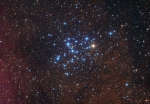 M6: The Butterfly Cluster
6.09.2011
To some, the outline of the open cluster of stars M6 resembles a butterfly. M6, also known as NGC 6405, spans about 20 light-years and lies about 2,000 light years distant.
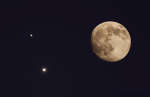 Venus and Jupiter are Close
2.07.2015
On June 30, Venus and Jupiter were close in western skies at dusk. Near the culmination of this year's gorgeous conjunction, the two bright evening planets are captured in the same telescopic field of view in this image taken after sunset from Bejing, China.
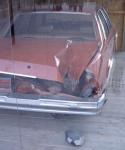 The Car, the Hole, and the Peekskill Meteorite
19.11.2006
The Peekskill meteor of 1992 was captured on 16 independent videos and then struck a car. Documented as brighter than the full Moon, the spectacular fireball crossed parts of several US states during its 40 seconds of glory before landing in Peekskill, New York.
 Sunset to Sunrise over the Baltic Sea
16.06.2023
This serene view from the coast of Sweden looks across the Baltic sea and compresses time, presenting the passage of one night in a single photograph. From sunset to sunrise, moonlight illuminates the creative sea and skyscape. Fleeting clouds, fixed stars, and flowing northern lights leave their traces in planet Earth's sky.
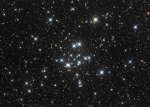 Star Cluster M34
11.02.2010
This pretty open cluster of stars, M34, is about the size of the Full Moon on the sky. Easy to appreciate in small telescopes, it lies some 1,800 light-years away in the constellation Perseus. At that distance, M34 physically spans about 15 light-years.
|
January February March April May June July August September October |
|||||||||||||||||||||||||||||||||||||||||||||||||