
|
You entered: meteors
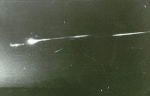 A Meteoric View of Apollo 13
9.07.1995
Meteors, also called shooting stars, normally begin as bits of dust from the tails of comets or even small pieces chipped off asteroids. Falling toward Earth, these particles enter the atmosphere at extremely high speeds. Friction with the air heats them up and makes them glow brightly.
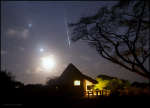 Kenya Morning Moon, Planets and Taurid
12.11.2015
On November 8, a waning crescent Moon joined the continuing parade of planets in Earth's morning skies. Captured here from Amboseli National Park, Kenya, even the overexposed moonlight can't washout brilliant Venus though, lined up near the ecliptic plane with faint Mars and bright Jupiter above.
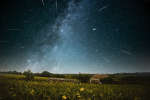 Three Perseid Nights
20.08.2021
Frames from a camera that spent three moonless nights under the stars create this composite night skyscape. They were recorded during August 11-13 while planet Earth was sweeping through the dusty trail of comet Swift-Tuttle.
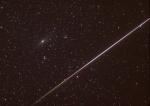 Island Universe, Cosmic Sand
23.08.2002
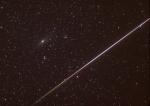
On August 13, while counting Perseid meteors under dark, early morning Arizona skies, Rick Scott set out to photograph their fleeting but fiery trails. The equipment he used included a telephoto lens and fast color film. After 21 pictures he'd caught only two meteors, but luckily this was one of them.
 Island Universe, Cosmic Sand
2.08.2003
On August 13, 2002, while counting Perseid meteors under dark, early morning Arizona skies, Rick Scott set out to photograph their fleeting but fiery trails. The equipment he used included a telephoto lens and fast color film. After 21 pictures he'd caught only two meteors, but luckily this was one of them.
 Perseid Trail
14.08.2008
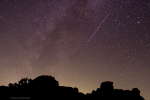
This bright and colorful meteor flashed through Tuesday's early morning skies, part of the annual Perseid Meteor Shower. The lovely image is one of over 350 frames captured on August 12 from...
 Quadrantids over the Great Wall
3.01.2020
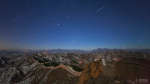
Named for a forgotten constellation, the Quadrantid Meteor Shower is an annual event for planet Earth's northern hemisphere skygazers The shower's radiant on the sky lies within the old, astronomically obsolete constellation Quadrans Muralis. That location is not far from the Big Dipper, at the boundaries of the modern constellations Bootes and Draco.
 Leonid Glowworm
28.04.2000
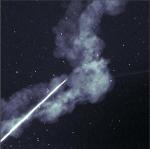
Recent Leonid meteor showers have been rich in bright fireball meteors which leave lingering trails stretching across the night sky. These trails, or persistent trains, are mysteriously self-luminescent and do not shine by reflected light.
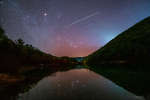 The Geminid
16.12.2022
Returning from beyond the Moon, on December 11 the Orion spacecraft entered Earth's atmosphere at almost 11 kilometers per second. That's half the speed of the grain of dust that created this long fireball meteor when it entered the atmosphere on December 13, near the peak of the annual Geminid meteor shower.
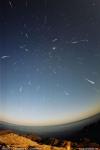 Leonids and Leica
18.11.2006
This lovely view from northern Spain at Cape Creus on the easternmost point of the Iberian peninsula, looks out across the Mediteranean and up into the stream of the 2002 Leonid meteor shower. The picture is a composite of thirty separate one minute exposures taken through a fisheye lens.
|
January February March April May June July August September |
|||||||||||||||||||||||||||||||||||||||||||||||||