
|
You entered: star trail
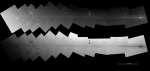 PanSTARRS: The Anti Tail Comet
29.06.2013
Once known as Earth's sunset comet, PanSTARRS (C/2011 L4) is up all night now, but only for northern hemisphere skygazers. Telescopes are required to track its progress as it fades and heads for the outer solar system.
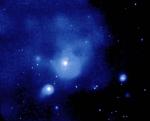 Fornax Cluster in Motion
24.09.2004
Reminiscent of popular images of the lovely Pleiades star cluster that lies within our own Milky Way Galaxy, this false-color x-ray view actually explores the center of a much more extended cosmic family -- the Fornax cluster of galaxies some 65 million light-years away.
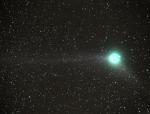 Comet Machholz in View
5.01.2005
Good views of Comet Machholz are in store for northern hemisphere comet watchers in January. Now making its closest approach to planet Earth, the comet will pass near the lovely Pleiades star cluster on January 7th and the double star cluster in Perseus on January 27th as Machholz moves relatively quickly through the evening sky.
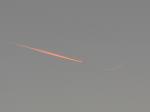 Jet Approaching a Crescent Moon
5.06.2007
No natural clouds appear in this picture. On the left, an airplane cruises through the atmosphere leaving a contrail in its wake. The contrail would normally appear white, but the large volume of air toward the setting Sun preferentially knocks away blue light, giving the reflected trail a bright orange hue.
 Fly Me to the Moon
17.01.2017
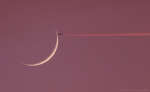
No, this is not a good way to get to the Moon. What is pictured is a chance superposition of an airplane and the Moon. The contrail would normally appear white, but the large volume of air toward the setting Sun preferentially knocks away blue light, giving the reflected trail a bright red hue.
 The Light of Stars
8.05.2012
What's moving? Time lapse videos of the sky can be quite spectacular when they last long enough for stars, planets, aurora, and clouds to appear to move in just a few seconds. Pictured...
 The Milky Trail
1.06.2013
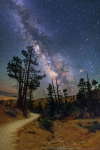
Have you ever hiked the Queen's Garden trail in Bryce Canyon, Utah, USA, planet Earth? Walking along that path in this dark night skyscape, you can almost imagine your journey continues along the pale, luminous Milky Way.
 A Blazing Fireball between the Orion Nebula and Rigel
16.11.2015
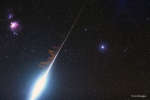
What's happening to that meteor? A few days ago, a bright fireball was photographed from the Alps mountain range in Switzerland as it blazed across the sky. The fireball, likely from the Taurids...
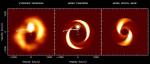 IP Pegasi: Spiral Star
22.08.1997
Spiral arms aren't just for galaxies. A hot disk of gas surrounding a compact white dwarf star in the constellation of Pegasus has recently been revealed to be imprinted with this dramatic pattern.
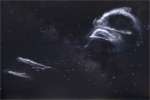 Rocket Trails in the Milky Way
29.03.2012
On March 27, five sounding rockets leapt into early morning skies from NASA's Wallops Flight Facility in Virginia. Part of the Anomalous Transport Rocket EXperiment (ATREX), begining at 4:58 am EDT the rockets launched consecutively at 80 second intervals.
|
January February March April May June July August September |
|||||||||||||||||||||||||||||||||||||||||||||||||