
|
You entered: stellar wind
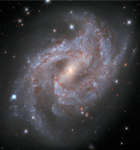 Supernova in NGC 2525
23.10.2020
Big, beautiful, barred spiral galaxy NGC 2525 lies 70 million light-years from the Milky Way. It shines in Earth's night sky within the boundaries of the southern constellation Puppis. About 60,000 light-years...
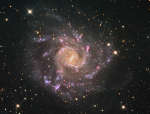 Grand Spiral Galaxy NGC 7424
8.01.2013
The grand, winding arms are almost mesmerizing in this face-on view of NGC 7424, a spiral galaxy with a prominent central bar. About 40 million light-years distant in the headlong constellation Grus, this island universe is also about 100,000 light-years across making it remarkably similar to our own Milky Way.
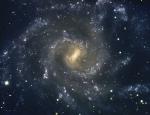 The Arms of NGC 7424
16.12.2004
The grand, winding arms are almost mesmerizing in this face-on view of NGC 7424, a spiral galaxy with a prominent central bar. About 40 million light-years distant in the headlong constellation Grus, this island universe is also about 100,000 light-years across making it remarkably similar to our own Milky Way.
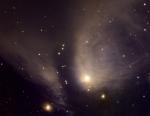 Portrait of RY Tauri
23.09.2005
A star emerges from its natal cloud of gas and dust in this tantalizing portrait of RY Tauri, a small stellar nursery at the edge of the Taurus molecular cloud, a mere 450 light-years away.
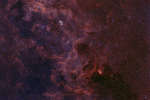 Cosmic Clouds in Cygnus
9.06.2022
These cosmic clouds of gas and dust drift through rich star fields along the plane of our Milky Way Galaxy toward the high flying constellation Cygnus. They're too faint to be seen with the unaided eye though, even on a clear, dark night.
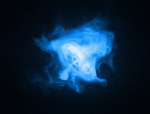 Crab Pulsar Wind Nebula
27.12.2008
The Crab Pulsar, a city-sized, magnetized neutron star spinning 30 times a second, lies at the center of this remarkable image from the orbiting Chandra Observatory. The deep x-ray image gives the first clear view of the convoluted boundaries of the Crab's pulsar wind nebula.
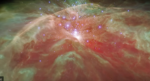 Flight Through the Orion Nebula in Infrared Light
7.07.2021
What would it look like to fly into the Orion Nebula? The exciting dynamic visualization of the Orion Nebula is based on real astronomical data and adept movie rendering techniques. Up close and personal...
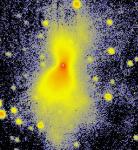 Cold Wind From The Boomerang Nebula
15.10.1997
A cold wind blows from the central star of the Boomerang Nebula. Seen here in a false color image of dust reflected starlight, the nebula lies about 5,000 light-years away. The boomerang shaped...
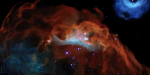 Journey into the Cosmic Reef
18.05.2020
What would you see if you could fly into the Cosmic Reef? The nebular cloud NGC 2014 appear to some like an ocean reef that resides in the sky, specifically in the LMC, the largest satellite galaxy of our Milky Way Galaxy.
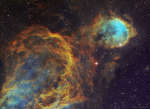 WR32 and Interstellar Clouds in Carina
8.02.2021
Stars can be like artists. With interstellar gas as a canvas, a massive and tumultuous Wolf-Rayet star has created the picturesque ruffled half-circular filaments called WR32, on the image left. Additionally, the winds...
|
January February March April May June July August September October |
|||||||||||||||||||||||||||||||||||||||||||||||||