
|
You entered: time
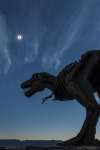 Eclipsosaurus Rex
7.10.2017
We live in an era where total solar eclipses are possible because at times the apparent size of the Moon can just cover the disk of the Sun. But the Moon is slowly moving away from planet Earth. Its distance is measured to increase about 1.5 inches (3.8 centimeters) per year due to tidal friction.
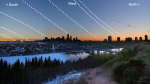 Equinox in the Sky
22.09.2020
Does the Sun set in the same direction every day? No, the direction of sunset depends on the time of the year. Although the Sun always sets approximately toward the west, on an equinox like today the Sun sets directly toward the west.
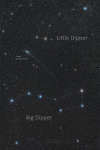 APOD: 2023 February 7 Б A Comet and Two Dippers
7.02.2023
Can you still see the comet? Yes. Even as C/2022 E3 (ZTF) fades, there is still time to see it if you know where and when to look. Geometrically, Comet ZTF has passed its closest to both the Sun and the Earth and is now headed back to the outer Solar System.
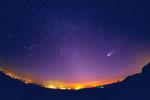 Sirius: The Brightest Star in the Night
11.06.2000
Sirius is the brightest star in the night sky. Sirius is visible on the far left of the above photograph, to the left of the constellation of Orion and Comet Hale-Bopp. Intrinsically, Sirius is over 20 times brighter than our Sun and over twice as massive.
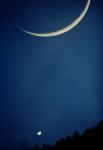 Moon And Venus Share The Sky
28.07.2000
July is drawing to a close and in the past few days, some early morning risers could have looked east and seen a crescent Moon sharing the pre-dawn skies with planets Jupiter and Saturn.
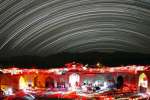 Running Messier s Marathon
19.04.2008
Gripped by an astronomical spring fever, many northern hemisphere stargazers embark on a Messier Marathon. Completing the marathon requires viewing all 110 objects in 18th century French astronomer Charles Messier's catalog in one glorious dusk-to-dawn observing run.
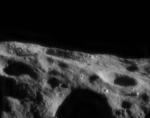 Eros At Sunset
24.08.2000
Gleaming in the rays of the setting sun, boulders litter the rugged surface of asteroid 433 Eros. The brightest boulder, at the edge of the large, shadowy crater near this picture's bottom center, is about 30 meters (100 feet) across.
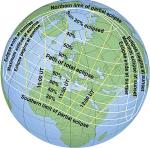 A Total Eclipse for Europe
10.08.1999
The last total solar eclipse of this millennium will be visible for a few minutes tomorrow from a narrow path in Europe and Asia. There, millions of sightseers will witness the Moon move directly between the Earth and Sun, covering up the Sun completely.
 The Tarantula and the Supernova
27.10.1995
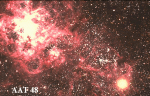
In this close-up of the Large Magellanic Cloud, the spidery looking nebula on the left is fittingly known as as the Tarantula nebula. It is an emission nebula surrounding a cluster of hot, young stars called the 30 Doradus super cluster.
 The Crab Nebula in X Rays
29.09.1999
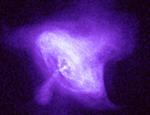
Why does the Crab Nebula still glow? In the year 1054 A.D. a supernova was observed that left a nebula that even today glows brightly in every color possible, across the entire electromagnetic spectrum. At the nebula's center is an ultra-dense neutron star that rotates 30 times a second.
|
January February March April May June July August September |
|||||||||||||||||||||||||||||||||||||||||||||||||