
|
You entered: planet
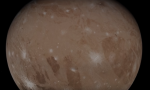 Juno Flyby of Ganymede and Jupiter
11.10.2021
What would it be like to fly over the largest moon in the Solar System? In June, the robotic Juno spacecraft flew past Jupiter's huge moon Ganymede and took images that have been digitally constructed into a detailed flyby.
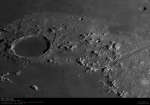 Plato and the Lunar Alps
15.01.2026
The dark-floored, 95 kilometer wide crater Plato and sunlit peaks of the lunar Alps (Montes Alpes) are highlighted in this this sharp telescopic snapshot of the Moon's surface. While the Alps of planet...
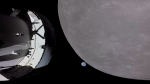 Earthset from Orion
24.01.2026
Eight billion people are about to disappear in this snapshot from space taken on 2022 November 21. On the sixth day of the Artemis I mission, their home world is setting behind the Moon's bright edge as viewed by an external camera on the outbound Orion spacecraft.
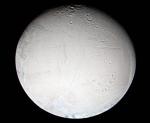 Ski Enceladus
24.02.2005
Small, icy, inner moon of Saturn, Enceladus is only about 500 kilometers in diameter. But the distant world does reflect over 90 percent of the sunlight it receives, giving its surface about the same reflectivity as fresh snow.
 Spirit Encounters Soft Ground on Mars
1.06.2009
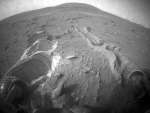
Will Spirit be able to free itself from soft ground on Mars? The robotic Spirit rover currently rolling across Mars ran into unexpectedly soft ground last month while exploring the red planet. A worry...
 Cosmic Rays at Voyager 1
8.09.2012
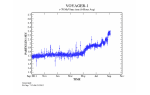
Launched on a grand tour of the outer planets in 1977, by good fortune the twin Voyager spacecraft were also headed in the general direction of the Sun's motion relative to nearby stars. Thirty five years later, Voyager 1 appears to be nearing the boundary of the Sun's heliosphere and interstellar space.
 Lenticular Cloud, Moon, Mars, Venus
1.03.2015
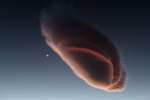
It is not every day that such an interesting cloud photobombs your image. The original plan was to photograph a rare angular conjunction of Mars and Venus that occurred a week and a half ago, with the added bonus of a crescent Moon and the International Space Station (ISS) both passing nearby.
 Nebula with Laser Beams
29.03.2017
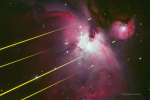
Four laser beams cut across this startling image of the Orion Nebula, as seen from ESO's Paranal Observatory in the Atacama desert on planet Earth. Not part of an interstellar conflict, the lasers...
 Trail of the Returner
31.12.2020
Familiar stars of a northern winter's night shine in this night skyview, taken near Zhangye, Gansu, China and the border with Inner Mongolia. During the early hours of December 17 Orion is near...
 Ship Tracks over the Pacific Ocean
8.06.2022
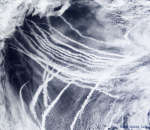
What are those unusual streaks? Some images of planet Earth show clear bright streaks that follow the paths of ships. Known as ship tracks, these low and narrow bands are caused by the ship's engine exhaust.
|
January February March April May June July August September October |
|||||||||||||||||||||||||||||||||||||||||||||||||