
|
You entered: star
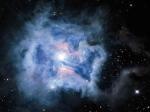 The Iris Nebula from CFHT
29.12.2005
Like delicate cosmic petals, these clouds of interstellar dust and gas have blossomed 1,300 light-years away in the fertile star fields of the constellation Cepheus. Sometimes called the Iris Nebula and dutifully cataloged as NGC 7023, this is not the only nebula in the sky to evoke the imagery of flowers.
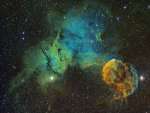 The Elusive Jellyfish Nebula
15.05.2010
Normally faint and elusive, the Jellyfish Nebula is caught in this alluring, false-color, telescopic view. Flanked by two bright stars, Mu and Eta Geminorum, at the foot of a celestial twin, the Jellyfish Nebula is the brighter arcing ridge of emission with dangling tentacles below and right of center.
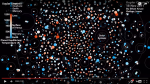 Kepler Orrery IV
5.12.2015
The exoplanet hunting Kepler mission's total for candidate and confirmed multiple planet systems stands at 1,705 worlds in orbit around 685 distant stars. Put all of those exoplanet orbits on the same scale and follow their relative orbital motions to get Kepler Orrery IV.
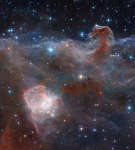 Horsehead: A Wider View
9.03.2018
Combined image data from the massive, ground-based VISTA telescope and the Hubble Space Telescope was used to create this wide perspective of the interstellar landscape surrounding the famous Horsehead Nebula. Captured at near-infrared wavelengths...
 NGC 2419: Intergalactic Wanderer
13.04.2023
Stars of the globular cluster NGC 2419 are packed into this Hubble Space Telescope field of view toward the mostly stealthy constellation Lynx. The two brighter spiky stars near the edge of the frame are within our own galaxy. NGC 2419 itself is remote though, some 300,000 light-years away.
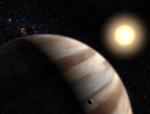 Extra Solar Planetary Atmosphere Detected
28.11.2001
By directly detecting the atmosphere of a planet outside our Solar System, humanity has taken another small step toward finding extraterrestrial life. The unexpected detection by David Charbonneau (Caltech) and associates came from Hubble Space Telescope observations of Sun-like star HD 209458.
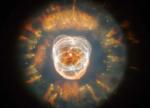 The Eskimo Nebula from Hubble
7.12.2003
In 1787, astronomer William Herschel discovered the Eskimo Nebula. From the ground, NGC 2392 resembles a person's head surrounded by a parka hood. In 2000, the Hubble Space Telescope imaged the Eskimo Nebula. From space, the nebula displays gas clouds so complex they are not fully understood.
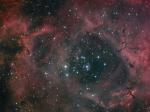 Dust and Light in the Rosette Nebula
14.02.2006
What creates the cosmic dust sculptures in the Rosette Nebula? Noted for the common beauty of its overall shape, parts of the Rosette Nebula, also known as NGC 2244, show beauty even when viewed up close.
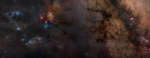 Dark River Wide Field
19.07.2010
A Dark River of dust seems to run from our Galactic Center, then pool into a starfield containing photogenic sky wonders. Scrolling right will reveal many of these objects including (can you find?)...
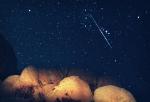 Bright Meteor, Dark Sky
20.08.1997
Has Orion the Hunter acquired a new weapon? If you turn your head sideways (counterclockwise) you might notice the familiar constellation of Orion, particularly the three consecutive bright stars that make up Orion's belt.
|
January February March April May June July August September October |
|||||||||||||||||||||||||||||||||||||||||||||||||