
|
You entered: stars
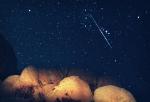 Bright Meteor, Dark Sky
20.08.1997
Has Orion the Hunter acquired a new weapon? If you turn your head sideways (counterclockwise) you might notice the familiar constellation of Orion, particularly the three consecutive bright stars that make up Orion's belt.
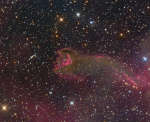 CG4: A Ruptured Cometary Globule
13.05.2014
Can a gas cloud grab a galaxy? It's not even close. The "claw" of this odd looking "creature" in the above photo is a gas cloud known as a cometary globule. This globule, however, has ruptured. Cometary globules are typically characterized by dusty heads and elongated tails.
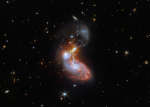 Merging Galaxy Pair IIZw096
2.12.2022
Bright at infrared wavelengths, this merging galaxy pair is some 500 million light-years away toward the constellation Delphinus. The cosmic mashup is seen against a background of even more distant galaxies, and occasional spiky foreground stars. But the galaxy merger itself spans about 100,000 light-years in this deep James Webb Space Telescope image.
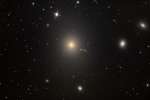 M87: Elliptical Galaxy with Jet
20.05.2010
In spiral galaxies, majestic winding arms of young stars, gas, and dust rotate in a flat disk around a bulging galactic nucleus. But elliptical galaxies seem to be simpler. Lacking gas and dust to form new stars, their randomly swarming older stars, give them an ellipsoidal (egg-like) shape. Still, elliptical galaxies can be very large.
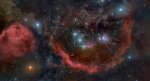 Orion: Head to Toe
23.10.2010
Cradled in cosmic dust and glowing hydrogen, stellar nurseries in Orion the Hunter lie at the edge of a giant molecular cloud some 1,500 light-years away. Spanning nearly 25 degrees, this breath-taking vista stretches across the well-known constellation from head to toe (left to right).
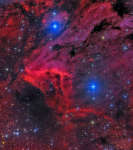 The Pelican Nebula in Red and Blue
1.03.2021
The Pelican Nebula is changing. The entire nebula, officially designated IC 5070, is divided from the larger North America Nebula by a molecular cloud filled with dark dust. The Pelican, however, is particularly interesting because it is an unusually active mix of star formation and evolving gas clouds.
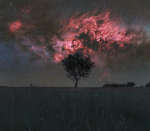 APOD: 2026 March 18 Б Cygnus and the Solitary Tree
18.03.2026
A lone tree stands in a quiet meadow in Guadalajara, Spain, silhouetted against the Cygnus region rising above like flames in the night sky. This deep night skyscape is a composite of exposures that reveals a range of brightness and color human eyes can't quite see on their own.
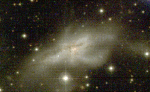 NGC 6240: When Galaxies Collide
28.12.1995
Sometimes even galaxies can suffer a fatal attraction. Here gravity causes two galaxies to collide in a spectacular display of energetic gas, dust, and light. When galaxies collide it is rare that any stars in the galaxies themselves collide, or that any change will be seen in a human lifetime.
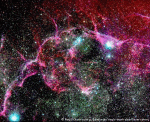 Vela Supernova Remnant in Optical
13.07.1997
About 11,000 years ago a star in the constellation of Vela exploded. This bright supernova may have been visible to the first human farmers. Today the Vela supernova remnant marks the position of a relatively close and recent explosion in our Galaxy. A roughly spherical, expanding shock wave is visible in X-rays.
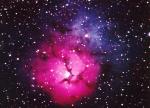 The Trifid Nebula in Red, White and Blue
8.12.1997
Three dark dust lanes give the picturesque Trifid Nebula its name. The red and blue colors of the Trifid Nebula are present in different regions and are created by different processes. A big bright star near the center of the red region appears white hot and emits light so energetic
|
January February March April May June July August September October |
|||||||||||||||||||||||||||||||||||||||||||||||||