
|
You entered: sky
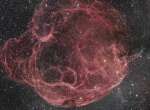 Simeis 147: Supernova Remnant
12.02.2011
It's easy to get lost following the intricate filaments in this detailed mosaic image of faint supernova remnant Simeis 147. Also cataloged as Sh2-240 and seen towards the constellation Taurus, it covers nearly 3 degrees (6 full moons) on the sky.
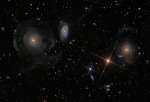 Shell Galaxies in Pisces
26.02.2011
This colorful cosmic skyscape features a peculiar system of galaxies cataloged as Arp 227 some 100 million light-years distant. Swimming within the boundaries of the constellation Pisces, Arp 227 consists of the two galaxies prominent on the left; the curious shell galaxy NGC 474 and its blue, spiral-armed neighbor NGC 470.
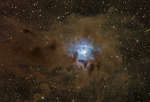 A Dusty Iris Nebula
4.08.2011
These clouds of interstellar dust and gas have blossomed 1,300 light-years away in the fertile star fields of the constellation Cepheus. Sometimes called the Iris Nebula and dutifully cataloged as NGC 7023, this is not the only nebula in the sky to evoke the imagery of flowers.
 Moon and Planets Over Catalonia
29.02.2012
Venus and Jupiter will appear unusually close in the sky over the next month. The planetary conjunction will be easily visible to the unaided eye because Venus will appear brighter than any background star, and Jupiter will be nearly as bright. To see the near-alignment, simply look to the west after sunset.
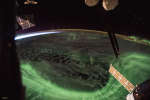 The Aurora and the Sunrise
1.05.2018
On the International Space Station (ISS), you can only admire an aurora until the sun rises. Then the background Earth becomes too bright. Unfortunately, after sunset, the rapid orbit of the ISS around the Earth means that sunrise is usually less than 47 minutes away.
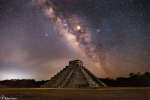 Milky Way over Pyramid of the Feathered Serpent
17.06.2019
To see the feathered serpent descend the Mayan pyramid requires exquisite timing. You must visit El Castillo -- in Mexico's YucatАn Peninsula -- near an equinox. Then, during the late afternoon if the sky is clear, the pyramid's own shadows create triangles that merge into the famous illusion of the slithering viper.
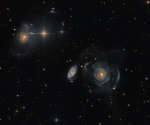 Shell Galaxies in Pisces
27.08.2020
This intergalactic skyscape features a peculiar system of galaxies cataloged as Arp 227 some 100 million light-years distant. Swimming within the boundaries of the constellation Pisces, Arp 227 consists of the two galaxies prominent right of center, the curious shell galaxy NGC 474 and its blue, spiral-armed neighbor NGC 470.
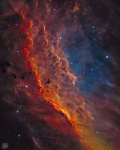 NGC 1499: The California Nebula
10.03.2021
Could Queen Calafia's mythical island exist in space? Perhaps not, but by chance the outline of this molecular space cloud echoes the outline of the state of California, USA. Our Sun has its home within the Milky Way's Orion Arm, only about 1,000 light-years from the California Nebula.
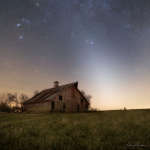 Zodiacal Light and Mars
11.03.2021
Just after sunset on March 7, a faint band of light still reaches above the western horizon in this serene, rural Illinois, night skyscape. Taken from an old farmstead, the luminous glow is zodiacal light, prominent in the west after sunset during planet Earth's northern hemisphere spring.
 Along the Taurus Molecular Cloud
23.11.2023
The cosmic brush of star formation composed this interstellar canvas of emission, dust, and dark nebulae. A 5 degree wide telescopic mosaic, it frames a region found north of bright star Aldebaran on the sky, at an inner wall of the local bubble along the Taurus molecular cloud.
|
January February March April May June July August September October |
|||||||||||||||||||||||||||||||||||||||||||||||||