
|
You entered: star
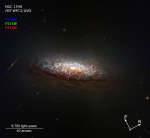 Hubble s NGC 1546
21.06.2024
Returning to science operations on June 14, the Hubble Space Telescope used its new pointing mode to capture this sharp image of spiral galaxy NGC 1546. A member of the Dorado galaxy group, the island universe lies a mere 50 million light-years away.
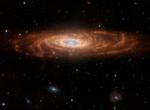 NGC 7331: A Galaxy So Inclined
1.07.2004
If our own Milky Way galaxy were 50 million light-years away with its disk inclined slightly to our line of sight, it would look a lot like large spiral galaxy NGC 7331. In fact...
 Cat s Eye Hubble Remix
22.03.2008
Staring across interstellar space, the alluring Cat's Eye Nebula lies three thousand light-years from Earth. One of the most famous planetary nebulae in the sky, the Cat's Eye (NGC 6543) is over half a light-year across and represents a final, brief yet glorious phase in the life of a sun-like star.
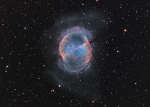 M27: Not a Comet
1.09.2011
While hunting for comets in the skies above 18th century France, astronomer Charles Messier diligently kept a list of the things he encountered that were definitely not comets. This is number 27 on his now famous not-a-comet list.
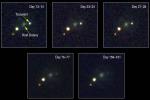 Gamma Ray Burst, Supernova Bump
17.05.2002
On the 21st of November 2001, satellites detected yet another burst of gamma-rays from the cosmos. While this flash of high-energy photons lasted for less than a minute, eager astronomers have been following the fading optical light from the location of the burst source ever since.
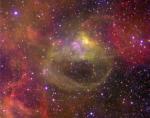 Energized Nebula in the LMC
10.04.2003
Blossoming in nearby galaxy the Large Magellanic Cloud (LMC), this gorgeous nebula is energized by radiation and winds from a massive star whose surface temperature approaches 100,000 degrees. The composite color image from...
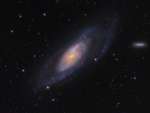 Messier 106
29.05.2009
Close to the Great Bear (Ursa Major) and surrounded by the stars of the Hunting Dogs (Canes Venatici), this celestial wonder was discovered in 1781 by the metric French astronomer Pierre Mechain. Later, it was added to the catalog of his friend and colleague Charles Messier as M106.
 Geostationary Highway
20.02.2010
Put a satellite in a circular orbit about 42,000 kilometers from the center of the Earth (36,000 kilometers or so above the surface) and it will orbit once in 24 hours. Because that matches Earth's rotation period, it is known as a geosynchronous orbit.
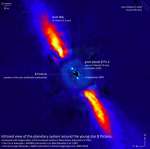 A Giant Planet for Beta Pic
3.07.2010
A mere 50 light-years away, young star Beta Pictoris became one of the most important stars in the sky in the early 1980s. Satellite and ground-based telescopic observations revealed the presence of a surrounding...
 APOD: 2025 June 27 Б Messier 109
27.06.2025
Big beautiful barred spiral galaxy Messier 109 is the 109th entry in Charles Messier's famous catalog of bright Nebulae and Star Clusters. You can find it just below the Big Dipper's bowl in the northern constellation Ursa Major.
|
January February March April May June July August September October |
|||||||||||||||||||||||||||||||||||||||||||||||||