
|
You entered: Orion Nebula
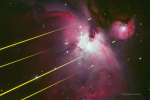 Nebula with Laser Beams
29.03.2017
Four laser beams cut across this startling image of the Orion Nebula, as seen from ESO's Paranal Observatory in the Atacama desert on planet Earth. Not part of an interstellar conflict, the lasers...
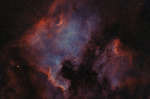 North America and the Pelican
8.09.2022
Fans of our fair planet might recognize the outlines of these cosmic clouds. On the left, bright emission outlined by dark, obscuring dust lanes seems to trace a continental shape, lending the popular name North America Nebula to the emission region cataloged as NGC 7000.
 Horizon to Horizon
21.12.2007
Scroll right and journey from horizon to horizon as your gaze sweeps through the zenith in the night sky over Beg-Meil, France. Recorded on December 13th, the entertaining panorama (image key) covers 210 degrees in 21 separate exposures, beginning on the beach with bright star Sirius rising in the southeast.
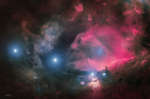 Orions Belt Region in Gas and Dust
11.01.2022
You may have seen Orion's belt before -- but not like this. The three bright stars across this image are, from left to right, Mintaka, Alnilam, and Alnitak: the iconic belt stars of Orion.
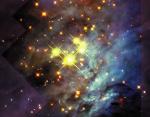 The Brown Dwarfs of Orions Trapezium
30.08.2000
The bright stars above are well known as heart of the Trapezium, an open cluster of stars in the center of the Orion Nebula. The many dim objects, however, are not well known, and have come to attention only on recent images in infrared light.
 The Horsehead Nebula
27.12.2017
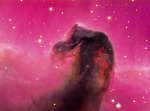
One of the most identifiable nebulae in the sky, the Horsehead Nebula in Orion, is part of a large, dark, molecular cloud. Also known as Barnard 33, the unusual shape was first discovered on a photographic plate in the late 1800s.
 UKIRT: Aloha Orion
6.01.2005
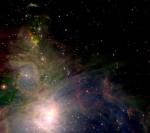
At the edge of a dense molecular cloud, filaments of gas, cosmic dust, and a multitude of young stars beckon in this penetrating image of the Orion Nebula. Alluring structures in the well-known star...
 The Horsehead Nebula from Blue to Infrared
28.07.2014
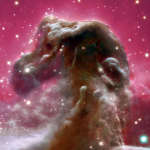
One of the most identifiable nebulae in the sky, the Horsehead Nebula in Orion, is part of a large, dark, molecular cloud. Also known as Barnard 33, the unusual shape was first discovered on a photographic plate in the late 1800s.
 The Blue Horsehead Nebula in Infrared
23.04.2018
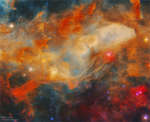
The Blue Horsehead Nebula looks quite different in infrared light. In visible light, the reflecting dust of the nebula appears blue and shaped like a horse's head. In infrared light, however, a complex labyrinth of filaments, caverns, and cocoons of glowing dust and gas emerges, making it hard to even identify the equine icon.
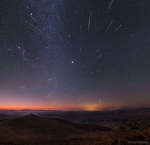 Geminid Meteors over Chile
8.12.2019
Are meteors streaming out from a point in the sky? Yes, in a way. When the Earth crosses a stream of Sun-orbiting meteors, these meteors appear to come from the direction of the stream -- with the directional point called the radiant.
|
January February March April May June July August September October |
|||||||||||||||||||||||||||||||||||||||||||||||||