
|
You entered: Solar System
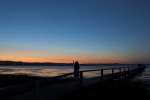 Planets Ahoy
30.09.2008
Can you spot the Solar System's four rocky planets? In the above image taken on September 20, all of them were visible in a single glance, but some of them may be different than you think. Pictured above, the brightest and highest object in the sky is the planet Venus.
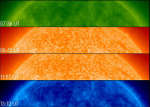 Mercury Spotting
27.05.2012
Can you spot the planet? The diminutive disk of Mercury, the solar system's innermost planet, spent about five hours crossing in front of the enormous solar disk in 2003, as viewed from the general vicinity of planet Earth.
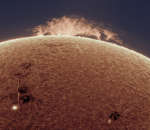 A Prominence on the Sun
18.09.2015
This eerie landscape of incandescent plasma suspended in looping and twisted magnetic fields stretched toward the Sun's eastern horizon on September 16. Captured through a backyard telescope and narrowband filter in light from ionized hydrogen, the scene reveals a gigantic prominence lofted above the solar limb.
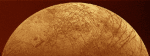 Europa: Ancient Water World
5.09.1995
Beneath the cold icy surface of Jupiter's moon Europa are probably the only oceans of water in our Solar System outside of Earth. These oceans, possibly 50 kilometers deep, might also be the most likely local place to find extra-terrestrial life.
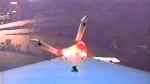 The Launch of STARDUST
5.04.1999
NASA launches powerful rockets. One such rocket, the Delta II, recently lofted the STARDUST mission into the nearby Solar System. STARDUST is expected to photograph Comet Wild in 2004 as it zooms by, and return interstellar dust samples to Earth in 2006.
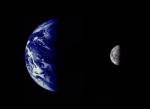 The Earth and Moon Planetary System
15.10.2001
How similar in size are the Earth and the Moon? A dramatic visual answer to this question is found by combining photographs taken by the Mariner 10 spacecraft that headed out toward Venus and Mercury in 1973.
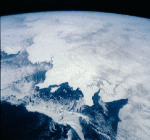 Water World
17.11.1995
Water (Dihydrogen Oxide, H2O) is a truly remarkable chemical compound and is fundamental to life on Earth. Earth is the only planet in the Solar System where the surface temperature and pressure allow the three forms of water, solid (ice), liquid (ocean), and gas (water vapor condensing in clouds) to exist simultaneously on its surface.
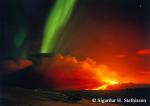 Volcano and Aurora in Iceland
20.01.2002
Sometimes both heaven and Earth erupt. In Iceland in 1991, the volcano Hekla erupted at the same time that auroras were visible overhead. Hekla, one of the most famous volcanoes in the world, has erupted at least 20 times over the past millennium, sometimes causing great destruction.
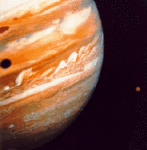 Jupiter, Io, and Ganymede's Shadow
12.10.1995
Jupiter, the solar system's largest planet, is seen here next to Io, its closest Galilean moon. On the cloud tops of Jupiter near the left edge of the picture can be seen a dark circular spot which is caused by the shadow of Jupiter's largest moon Ganymede.
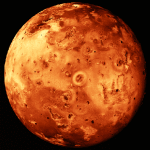 Io: A Volcanic Moon
3.08.1995
In 1610, Galileo turned his telescope to the heavens and discovered that the planet Jupiter had four bright moons. The innermost of these Galilean moons, Io, turned out to be one of the most exotic objects in the solar system.
|
January February March April May June July August |
||||||||||||||||||||||||||||||||||||||||||||||||||||||||