
|
You entered: full moon
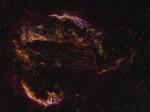 The Veil Nebula Unveiled
6.12.2005
These wisps of gas are all that remain visible of a Milky Way star. Many thousands of years ago that star exploded in a supernova leaving the Veil Nebula, pictured above. At the time...
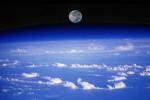 Moonset, Planet Earth
28.10.2000
During the Astro-1 astronomy mission of December, 1990, Space Shuttle astronauts photographed this stunning view of the full moon rising above the Earth's limb. In the foreground, towering clouds of condensing water vapor mark the extent of the troposphere, the lowest layer of the planet's life-sustaining atmosphere.
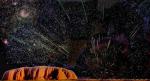 Leonids Over Ayers Rock
30.10.2002
Will this year's Leonid meteor shower be as good as last year's? No one knows for sure. Possibly, however, in the waning nighttime hours of November 18 and lasting throughout much of November 19, sky gazers across the globe may get their last chance ever to see a meteor storm.
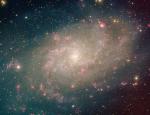 Nearby Spiral M33
2.12.2002
Spiral galaxy M33 is a mid-sized member of our Local Group of Galaxies. M33 is also called the Triangulum Galaxy for the constellation in which it resides. About four times smaller (in radius) than...
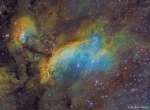 IC 4628: The Prawn Nebula
4.07.2016
South of Antares, in the tail of the nebula-rich constellation Scorpius, lies emission nebula IC 4628. Nearby hot, massive stars, millions of years young, radiate the nebula with invisible ultraviolet light, stripping electrons from atoms. The electrons eventually recombine with the atoms to produce the visible nebular glow, dominated by the red emission of hydrogen.
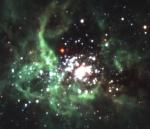 Tarantula
4.06.1997
NGC 2070 is an immense star forming region in a nearby galaxy known as the Large Magellanic Cloud. Its spidery appearance is responsible for its popular name, "The Tarantula Nebula", except that this tarantula is about 1,000 light-years across, and 165,000 light-years away in the southern constellation Dorado.
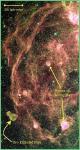 Stellar Laboratories in the LMC
25.07.1997
Stars are evolving in the Large Magellanic Clouds (LMC). This is particularly evident in the above close-up of the LMC's edge, which appears about as large as the full moon. Visible only...
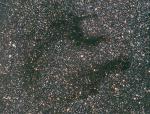 The E Nebula in Aquila
20.08.2003
Several unusual strands of darkness are prominent toward the constellation of Aquila. This particular dark nebula is known as the E Nebula, for its evocative shape, or B142 and B143, for its position(s) on a list of such nebula compiled by Barnard.
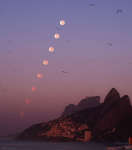 Rio Morning Moonset
20.04.2011
As the Sun rose, a nearly full Moon set in this serene seaside vista captured last Monday from Rio de Janeiro, Brazil. In the foreground, the reddened early morning sunlight illuminates a stretch of South Atlantic coastline.
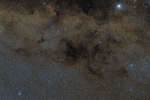 Rigil Kentaurus and Sandqvist 169
13.04.2019
Rigil Kentaurus is the bright star near the top of this broad southern skyscape. Of course it's probably better known as Alpha Centauri, nearest star system to the Sun. Below it sprawls a dark nebula complex.
|
January February March April May June July August September October |
|||||||||||||||||||||||||||||||||||||||||||||||||