
|
You entered: jet
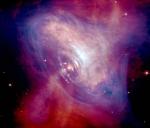 Composite Crab
4.09.2003
The Crab Pulsar, a city-sized, magnetized neutron star spinning 30 times a second, lies at the center of this composite image of the inner region of the well-known Crab Nebula. The spectacular picture combines...
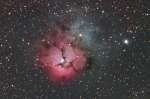 A Beautiful Trifid
30.05.2009
The beautiful Trifid Nebula is a colorful study in cosmic contrasts. Also known as M20, it lies about 5,000 light-years away toward the nebula rich constellation Sagittarius. A star forming region...
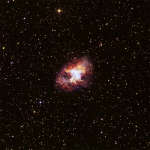 Cosmic Crab Nebula
25.07.2014
The Crab Pulsar, a city-sized, magnetized neutron star spinning 30 times a second, lies at the center of this tantalizing wide-field image of the Crab Nebula. A spectacular picture of one of our Milky Way's supernova remnants, it combines optical survey data with X-ray data from the orbiting Chandra Observatory.
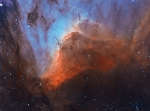 Pelican Nebula Close Up
3.08.2017
The prominent ridge of emission featured in this vivid skyscape is designated IC 5067. Part of a larger emission region with a distinctive shape, popularly called The Pelican Nebula, the ridge spans about 10 light-years and follows the curve of the cosmic pelican's head and neck.
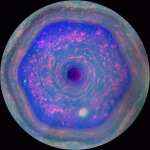 Saturn s North Polar Hexagon
7.09.2018
In full view, the amazing six-sided jet stream known as Saturn's north polar hexagon is shown in this colorful Cassini image. Extending to 70 degrees north latitude, the false-color video frame is map-projected, based on infrared, visible, and ultraviolet image data recorded by the Saturn-orbiting spacecraft in late 2012.
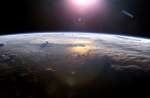 Yuri s Planet
12.04.2008
On April 12th, 1961, Soviet cosmonaut Yuri Alexseyevich Gagarin became the first human in space. His remotely controlled Vostok 1 spacecraft lofted him to an altitude of 200 miles and carried him once around planet Earth. Commenting on the first view from space he reported, "The sky is very dark; the Earth is bluish.
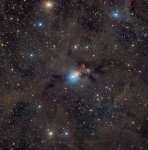 Stardust in the Perseus Molecular Cloud
18.03.2021
Clouds of stardust drift through this deep skyscape, across the Perseus molecular cloud some 850 light-years away. Dusty nebulae reflecting light from embedded young stars stand out in the nearly 2 degree wide telescopic field of view.
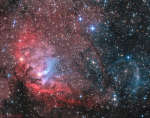 The Tulip and Cygnus X-1
1.09.2022
Framing a bright emission region, this telescopic view looks out along the plane of our Milky Way Galaxy toward the nebula rich constellation Cygnus the Swan. Popularly called the Tulip Nebula, the reddish glowing cloud of interstellar gas and dust is also found in the 1959 catalog by astronomer Stewart Sharpless as Sh2-101.
 APOD: 2025 February 19 Б HH 30: A Star System with Planets Now Forming
19.02.2025
How do stars and planets form? New clues have been found in the protoplanetary system Herbig-Haro 30 by the James Webb Space Telescope in concert with Hubble and the Earth-bound ALMA. The observations show, among other things, that large dust grains are more concentrated into a central disk where they can form planets.
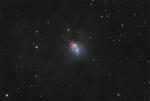 Dusty NGC 1300
6.10.2006
Dusty NGC 1333 is seen in visible light as a reflection nebula, dominated by bluish hues characteristic of starlight reflected by dust. But at longer infrared wavelengths, the interstellar dust itself glows. Moving your...
|
January February March April May June July August September |
|||||||||||||||||||||||||||||||||||||||||||||||||