
|
You entered: north star
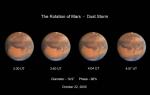 October Mars
28.10.2005
This October, Mars has become a bright, yellowish star in planet Earth's sky as it approaches oppositon, the period when Mars and Earth pass close as they orbit the Sun. How close is Mars? A mere 70 million kilometers or so, close enough to allow Earth-bound astronomers excellent views of the alluring Red Planet.
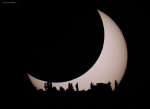 APOD: 2026 August 9 Б Contemplating the Sun
9.08.2026
Have you contemplated your home star recently? Featured here, a Sun partially eclipsed on the top left by the Moon is also seen eclipsed by earthlings contemplating the eclipse below. This spectacular menagerie...
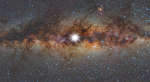 Solstice Sun and Milky Way
21.12.2017
Welcome to December's solstice, first day of winter in the north and summer for the southern hemisphere. Astronomical markers of the seasons, solstice and equinox dates are based on the Sun's place in its annual journey along the ecliptic, through planet Earth's sky.
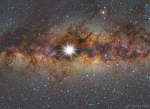 Solstice Sun and Milky Way
21.12.2021
Welcome to December's solstice, first day of winter in the north and summer for the southern hemisphere. Astronomical markers of the seasons, solstice and equinox dates are based on the Sun's place in its annual journey along the ecliptic, through planet Earth's sky.
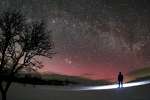 Comet of the North
5.04.2013
It looks like a double comet, but Comet PanSTARRS (C/2011 L4) is just offering skygazers a Messier moment. Outward bound and fading in this starry scene, the well-photographed comet is remarkably similar in brightness to M31, the Andromeda Galaxy.
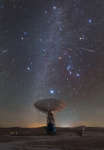 Geminids of the North
15.12.2017
Earth's annual Geminid meteor shower did not disappoint as our fair planet plowed through dust from active asteroid 3200 Phaethon. Captured in this northern hemisphere nightscape, the meteors stream away from the shower's radiant in Gemini.
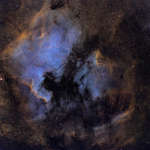 North America and the Pelican
18.12.2010
Here lie familiar shapes in unfamiliar locations. On the left is an emission nebula cataloged as NGC 7000, famous partly because it resembles our fair planet's continent of North America. The emission region to the right of the North America Nebula is IC 5070, also known for its suggestive outlines as the Pelican Nebula.
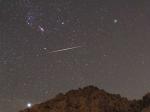 Comet, Meteor, Nebula, Star
22.12.2004
Several wonders of the late-year northern sky appeared together for a few fleeting moments on December 13. On the bottom left, just above the hill, is blue Sirius, the brightest star in the sky.
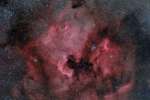 North America and the Pelican
3.09.2013
Here lie familiar shapes in unfamiliar locations. On the left is an emission nebula cataloged as NGC 7000, famous partly because it resembles our fair planet's continent of North America. The emission region to the right of the North America Nebula is IC 5070, also known for its suggestive outlines as the Pelican Nebula.
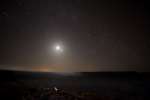 The Grand Canyon in Moonlight
30.03.2012
In this alluring night skyscape recorded on March 26, a young Moon stands over the distant western horizon in conjunction with brilliant planet Venus. In the foreground, the Colorado River glistens in moonlight as it winds through the Grand Canyon, seen from the canyon's southern rim at Lipan Point.
|
January February March April May June July August |
||||||||||||||||||||||||||||||||||||||||||||||||||||||||