
|
You entered: red giant
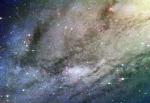 Southwest Andromeda
17.09.2001
This new image composite of the southwest region of M31 from the Subaru Telescope shows many stars, nebulae, and star clusters never before resolved. An older population of stars near Andromeda's center causes the yellow hue visible on the upper right. Young blue stars stand out in the spiral arms on the lower left.
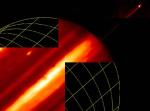 Jupiter: Moon, Ring, and Clouds
20.11.1997
An inner moon, an edge-on, planet-girdling ring, and high altitude cloud bands are visible in this mosaic of infrared images of gas giant Jupiter. The moon Metis, 25 miles wide and about 80,000 miles from the planet, is the bright spot at the upper right.
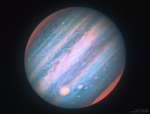 Jupiter in Infrared from Hubble
20.02.2018
Jupiter looks a bit different in infrared light. To better understand Jupiter's cloud motions and to help NASA's robotic Juno spacecraft understand the Hubble Space Telescope is being directed to regularly image the entire Jovian giant.
 Approaching Jupiter
22.05.2017
What would it look like to approach Jupiter? To help answer this, a team of 91 amateur astrophotographers took over 1,000 pictures of Jupiter from the Earth with the resulting images aligned and digitally merged into the featured time-lapse video. Image taking began in 2014 December and lasted just over three months.
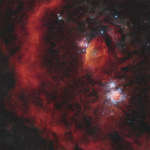 APOD: 2026 February 18 Б Orions Cradle
17.02.2026
Cradled in red-glowing hydrogen gas, stars are being born in Orion. These stellar nurseries lie at the edge of the giant Orion molecular cloud complex, some 1,500 light-years away. This detailed view spans...
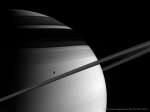 Saturn, Tethys, Rings, and Shadows
22.01.2022
Seen from ice moon Tethys, rings and shadows would display fantastic views of the Saturnian system. Haven't dropped in on Tethys lately? Then this gorgeous ringscape from the Cassini spacecraft will have to do for now.
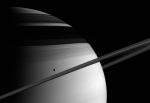 Tethys, Rings, and Shadows
22.07.2005
Seen from ice moon Tethys, rings and shadows would play across fantastic views of the Saturnian system. Haven't dropped in on Tethys lately? Then this gorgeous ringscape from the Cassini spacecraft will have to do for now.
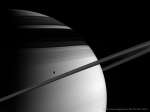 Saturn, Tethys, Rings, and Shadows
4.04.2015
Seen from ice moon Tethys, rings and shadows would display fantastic views of the Saturnian system. Haven't dropped in on Tethys lately? Then this gorgeous ringscape from the Cassini spacecraft will have to do for now.
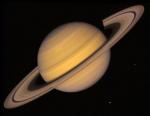 Saturn, Rings, and Two Moons
17.01.1998
NASA's robot spacecraft Voyager 2 made this image of Saturn as it began to explore the Saturn system in 1981. Saturn's famous rings are visible along with two of its moons, Rhea and Dione which appear as faint dots on the right and lower right part of the picture.
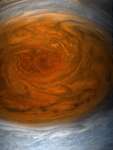 Close up of the Great Red Spot
14.07.2017
On July 11, the Juno spacecraft once again swung near to Jupiter's turbulent cloud tops in its looping 53 day orbit around the Solar System's ruling gas giant. About 11 minutes after perijove 7, its closest approach on this orbit, it passed directly above Jupiter's Great Red Spot.
|
January February March April May June July August September October |
|||||||||||||||||||||||||||||||||||||||||||||||||