
|
You entered: planets
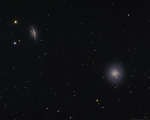 Cetus Galaxies and Supernova
6.12.2018
Large spiral galaxy NGC 1055 at top left joins spiral Messier 77 (bottom right) in this cosmic view toward the aquatic constellation Cetus. The narrowed, dusty appearance of edge-on spiral NGC 1055 contrasts nicely with the face-on view of M77's bright nucleus and spiral arms.
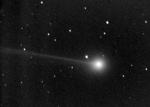 Comet Ikeya Zhang
21.02.2002
Comet Ikeya-Zhang is presently heading north in planet Earth's sky, framed by stars of the constellation Cetus. The comet was discovered as a faint, telescopic object near the western horizon on the evening...
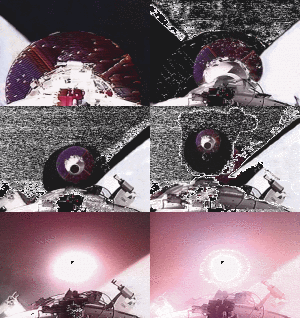 Opportunity Rockets Toward Mars
22.09.2003
Next stop: Mars. Two months ago, the second of two missions to Mars was launched from Cape Canaveral, Florida, USA above a Boeing Delta II rocket. The Mars Exploration Rover dubbed Opportunity is expected to arrive at the red planet this coming January.
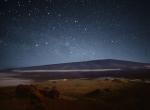 Southern Cross in Mauna Loa Skies
29.01.2005
Gazing across this gorgeous skyscape, the Southern Cross and stars of the constellation Centaurus are seen above the outline of Mauna Loa (Long Mountain), planet Earth's largest volcano. Unfamiliar to sky gazers north...
 Comet and Orion
2.10.2009
These colorful panels both feature a familiar northern hemisphere astronomical sight: the stellar nursery known as the Great Orion Nebula. They also offer an intriguing and unfamiliar detail of the nebula rich skyscape -- a passing comet.
 Perseid Below
17.08.2011
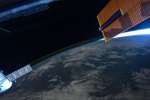
Denizens of planet Earth watched this year's Perseid meteor shower by looking up into the moonlit night sky. But this remarkable view captured by astronaut Ron Garan looks down on a Perseid meteor.
 A Candidate for the Biggest Boom Yet Seen
26.01.2016
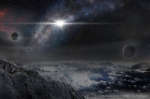
It is a candidate for the brightest and most powerful explosion ever seen -- what is it? The flaring spot of light was found by the All Sky Automated Survey for Supernovae (ASASSN) in June of last year and labelled ASASSN-15lh.
 Moon behind Lava Fountain
4.09.2018
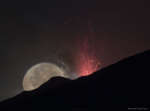
What's happened to the Moon? Nothing, but something has happened to the image of the Moon. The heat from a volcanic lava fountain in the foreground has warmed and made turbulent the air nearby, causing passing light to refract differently than usual.
 A Charioteer s Comet
1.03.2019
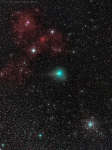
Still racing across planet Earth's night skies, Comet Iwamoto (C/2018 Y1) shares this pretty telescopic field of view with stars and nebulae of northern constellation Auriga, the Charioteer. Captured on February 27, Iwamoto's greenish coma and faint tail appear between a complex of reddish emission nebulae and open star cluster M36 (bottom right).
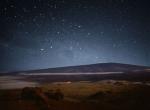 Southern Cross in Mauna Loa Skies
25.04.2002
Gazing across this gorgeous skyscape, the Southern Cross and stars of the constellation Centaurus are seen above the outline of Mauna Loa (Long Mountain), planet Earth's largest volcano. Unfamiliar to sky gazers north...
|
January February March April May June July August September October |
|||||||||||||||||||||||||||||||||||||||||||||||||