
|
You entered: planet
 APOD: 2024 February 12 Б HFG1 & Abell 6: Planetary Nebulae
12.02.2024
Planetary nebulae like Heckathorn-Fesen-Gull 1 (HFG1) and Abell 6 in the constellation Cassiopeia are remnants from the last phase of a medium sized star like our Sun. In spite of their shapes, planetary nebulae have nothing in common with actual planets.
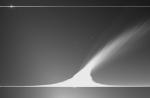 The Iron Tail of Comet McNaught
4.05.2007
Outstanding in planet Earth's sky early this year, Comet McNaught is captured in this view from the STEREO A spacecraft. McNaught's coma is so bright, it blooms into the long horizontal stripe at the bottom of the field.
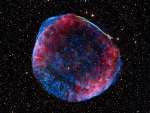 SN 1006 Supernova Remnant
4.07.2008
A new star, likely the brightest supernova in recorded human history, lit up planet Earth's sky in the year 1006 AD. The expanding debris cloud from the stellar explosion, found in the southerly constellation of Lupus, still puts on a cosmic light show across the electromagnetic spectrum.
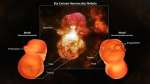 3D Homunculus Nebula
17.07.2014
If you're looking for something to print with that new 3D printer, try out a copy of the Homunculus Nebula. The dusty, bipolar cosmic cloud is around 1 light-year across but is slightly scaled down for printing to about 1/4 light-nanosecond or 80 millimeters.
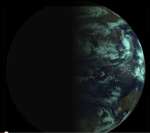 Earth at Equinox
22.09.2014
Earth is at equinox. Over the next 24 hours, day and night have nearly equal duration all over planet Earth. Technically, equinox transpires at 2:29 am Universal Time tomorrow, but this occurs today in North and South America.
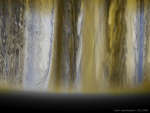 Jupiters Clouds from New Horizons
26.06.2016
The New Horizons spacecraft took some stunning images of Jupiter on its way out to Pluto. Famous for its Great Red Spot, Jupiter is also known for its regular, equatorial cloud bands, visible through even modest sized telescopes.
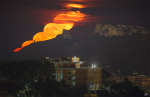 Strawberry Supermoon Over Devils Saddle
4.07.2022
Near the horizon the full moon often seems to loom large, swollen in appearance by the famous Moon illusion. But time-lapse image sequences demonstrate that the Moon's angular size doesn't really change as it rises or sets. Its color does, though.
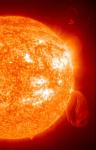 Maximum Sun
1.03.2001
Astronomers recently witnessed an astounding, large scale solar event as the Sun's north and south magnetic poles changed places! But, this complete solar magnetic field flip was actually anticipated. It occurs every 11 years during the maximum of the solar activity cycle.
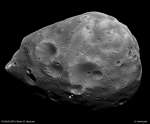 Phobos from Mars Express
17.03.2010
Why is this small object orbiting Mars? The origin of Phobos, the larger of the two moons orbiting Mars, remains unknown. Phobos and Deimos appear very similar to C-type asteroids, yet gravitationally capturing such asteroids, circularizing their orbits, and dragging them into Mars' equatorial plane seems unlikely.
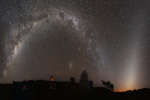 Zodiacal Light Over Namibia
13.09.2010
An unusual triangle of light is visible this time of year just before dawn, in the northern hemisphere. Once considered a false dawn, this triangle of light is actually zodiacal light, light reflected from interplanetary dust particles.
|
January February March April May June July August September October |
|||||||||||||||||||||||||||||||||||||||||||||||||