
|
You entered: NASA
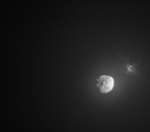 DART Asteroid Impact from Space
29.09.2022
Fifteen days before impact, the DART spacecraft deployed a small companion satellite to document its historic planetary defense technology demonstration. Provided by the Italian Space Agency, the Light Italian CubeSat for Imaging Asteroids, aka LICIACube, recorded this image of the event's aftermath.
 A Plutonian Landscape
15.05.2025
This shadowy landscape of majestic mountains and icy plains stretches toward the horizon on a small, distant world. It was captured from a range of about 18,000 kilometers when New Horizons looked back toward Pluto, 15 minutes after the spacecraft's closest approach on July 14, 2015.
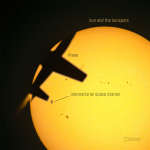 APOD: 2026 September 22 Б Chance Triple Alignment: Plane, Space Station, Sun
22.09.2026
This shot captured an unexpected silhouette. Which is it? It isn't the sunspots, the small dark regions caused by concentrated magnetic fields visible around the Sun's bright disk. Sunspots typically last for weeks and were expected, since these spots were seen previously.
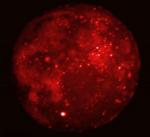 Eclipsed Moon in Infrared
15.09.2001
The total lunar eclipse of September 1996 disappointed many observers in North America who were cursed with cloudy skies. However, the Midcourse Space Experiment (MSX) satellite had a spectacular view from Earth orbit and SPIRIT III, an onboard infrared telescope, was used to repeatedly image the moon during the eclipse.
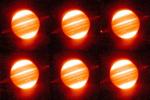 Running Red Rings Around Jupiter
5.02.1997
Jupiter has rings, too. Unlike Saturn's bright rings which are composed of chunks of ice, Jupiter's rings are darker and appear to consist of fine particles of rock. The six pictures above...
 Comet Hale-Bopp Outbound
10.09.1997
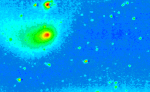
Hale-Bopp, the Comet of the Century, is leaving the inner Solar System. Outbound at about 12 miles per second it is presently nearing the main asteroid belt between Mars and Jupiter. This false-color image represents a recent view from low Earth orbit showing the comet surrounded by its shrinking coma against a background of stars.
 T Pyxidis: Recurrent Nova
25.09.1997
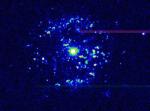
What happens when a thermonuclear blast occurs on the surface of a white dwarf star? Over the years astronomers have watched (at a safe distance ...) as, 6,000 light years from Earth in the southern constellation Pyxis, a binary star known as T Pyxidis repeatedly produces these fearsome explosions.
 Uranian Moons, Rings, And Clouds
26.11.1997
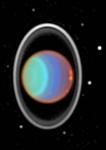
The giant planet Uranus is faint and featureless when viewed in visible light. But this pair of near-infrared mosaics from the Hubble Space Telescope's NICMOS camera reveals moons, rings, and clouds of this distant gas planet.
 Helios Helium
16.05.1998
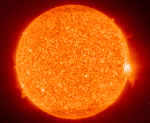
This image of the relatively quiet Sun was made using ultraviolet light emitted by ionized Helium atoms in the Solar chromosphere. Helium was first discovered in the Sun in 1868, its name fittingly derived from from the Greek word Helios, meaning Sun.
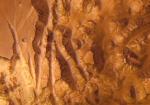 Valles Marineris from Mars Express
24.01.2004
Looking down from orbit on January 14, ESA's Mars Express spacecraft scanned a 1700 by 65 kilometer swath across Valles Marineris - the Grand Canyon of Mars - with its remarkable High Resolution Stereo Camera.
|
January February March April May June July August September October |
|||||||||||||||||||||||||||||||||||||||||||||||||