
|
You entered: star
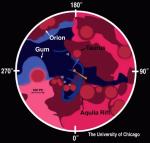 The Solar Neighborhood
25.02.1998
You are here. The orange dot in the above false-color drawing represents the current location of the Sun among local gas clouds in the spiral Milky Way Galaxy. These gas clouds are so thin that we usually see right through them. Nearly spherical bubbles surround regions of recent star formation.
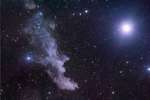 A Witch by Starlight
31.10.2008
By starlight this eerie visage shines in the dark, a crooked profile evoking its popular name, the Witch Head Nebula. In fact, this entrancing telescopic portrait gives the impression the witch has fixed her gaze on Orion's bright supergiant star Rigel.
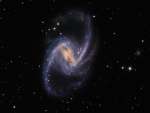 NGC 1365: Majestic Island Universe
20.08.2010
Barred spiral galaxy NGC 1365 is truly a majestic island universe some 200,000 light-years across. Located a mere 60 million light-years away toward the chemical constellation Fornax, NGC 1365 is a dominant member of the well-studied Fornax galaxy cluster.
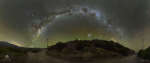 Puzzling a Sky over Argentina
26.07.2016
Can you find the comet? True, a careful eye can find thousands of stars, tens of constellations, four planets, three galaxies, and the central band of our Milky Way Galaxy -- all visible in the sky of this spectacular 180-degree panorama.
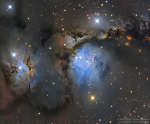 M78 and Orion Dust Reflections
24.01.2017
In the vast Orion Molecular Cloud complex, several bright blue nebulas are particularly apparent. Pictured here are two of the most prominent reflection nebulas - dust clouds lit by the reflecting light of bright embedded stars. The more famous nebula is M78, in the image center, cataloged over 200 years ago.
 NGC 1365: Majestic Island Universe
28.12.2018
Barred spiral galaxy NGC 1365 is truly a majestic island universe some 200,000 light-years across. Located a mere 60 million light-years away toward the chemical constellation Fornax, NGC 1365 is a dominant member of the well-studied Fornax galaxy cluster.
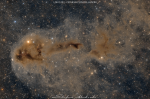 Lynds Dark Nebula 1251
24.11.2022
Stars are forming in Lynds Dark Nebula (LDN) 1251. About 1,000 light-years away and drifting above the plane of our Milky Way galaxy, the dusty molecular cloud is part of a complex of dark nebulae mapped toward the Cepheus flare region.
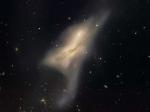 The Colliding Galaxies of NGC 520
12.09.2005
Is this one galaxy or two? The jumble of stars, gas, and dust that is NGC 520 is now thought to incorporate the remains of two separate galaxies. A combination of observations and simulations indicate the NGC 520 is actually the collision of two disk galaxies.
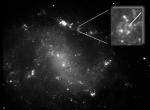 ESO 184 G82: and the Supernova Gamma Ray Burst Connection
28.02.2002
Modern astronomers keep a long list of things that go bump in the night. Near the top are supernovae - the death explosions of massive stars, and gamma-ray bursts - the most powerful explosions seen across the Universe.
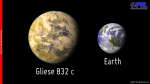 Gliese 832c: The Closest Potentially Habitable Exoplanet
9.07.2014
This planet is only 16 light years away -- could it harbor life? Recently discovered exoplanet Gliese 832c has been found in a close orbit around a star that is less bright than our Sun.
|
January February March April May June July August September October |
|||||||||||||||||||||||||||||||||||||||||||||||||