
|
You entered: Deep Sky
 Deep Magellanic Clouds Image Indicates Collisions
24.07.2016
Did the two most famous satellite galaxies of our Milky Way Galaxy once collide? No one knows for sure, but a detailed inspection of deep images like that featured here give an indication that they have.
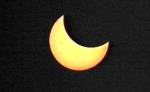 A Partial Eclipse in Southern Skies
3.09.1997
Location is everything, especially if you want to see a Solar Eclipse. These fleeting events are only visible to those in the path of the Moon's shadow as it races across the Earth.
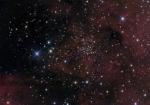 Tombaugh 4
21.10.2006
Clyde Tombaugh discovered planet Pluto in 1930 while surveying the skies with the 13-inch Lawrence Lowell Telescope. But the skilled and careful astronomer also went on to discover star clusters, comets, asteroids, and clusters of galaxies. For example, pictured is galactic or open star cluster Tombaugh 4 in the northern constellation Cassiopeia.
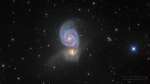 M51: The Whirlpool Galaxy
18.10.2017
Find the Big Dipper and follow the handle away from the dipper's bowl until you get to the last bright star. Then, just slide your telescope a little south and west and you'll come upon this stunning pair of interacting galaxies, the 51st entry in Charles Messier's famous catalog.
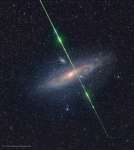 Meteor before Galaxy
6.08.2022
What's that green streak in front of the Andromeda galaxy? A meteor. While photographing the Andromeda galaxy in 2016, near the peak of the Perseid Meteor Shower, a small pebble from deep space crossed right in front of our Milky Way Galaxy's far-distant companion.
 APOD: 2025 August 6 Б Meteor before Galaxy
5.08.2025
What's that green streak in front of the Andromeda galaxy? A meteor. While photographing the Andromeda galaxy in 2016, near the peak of the Perseid Meteor Shower, a small pebble from deep space crossed right in front of our Milky Way Galaxy's far-distant companion.
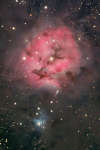 IC 5146: The Cocoon Nebula
26.08.2022
Inside the Cocoon Nebula is a newly developing cluster of stars. Cataloged as IC 5146, the beautiful nebula is nearly 15 light-years wide. Climbing high in northern summer night skies, it's located some 4,000 light years away toward the constellation Cygnus the Swan.
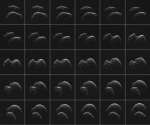 Asteroid 2014 JO25
19.04.2017
A day before its closest approach, asteroid 2014 JO25 was imaged by radar with the 70-meter antenna of NASA's Goldstone Deep Space Communications Complex in California. This grid of 30 radar images, top left to lower right, reveals the two-lobed shape of the asteroid that rotates about once every five hours.
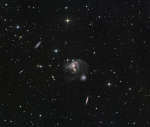 Hickson 91 in Piscis Austrinus
23.03.2016
Scanning the skies for galaxies, Canadian astronomer Paul Hickson and colleagues identified some 100 compact groups of galaxies, now appropriately called Hickson Compact Groups (HCGs). This sharp telescopic image captures one such galaxy group, HCG 91, in beautiful detail.
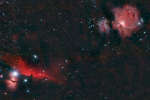 Horsehead and Orion Nebulae
9.03.2009
Adrift 1,500 light-years away in one of the night sky's most recognizable constellations, the glowing Orion Nebula and the dark Horsehead Nebula are contrasting cosmic vistas. They appear in opposite corners of this stunning mosaic taken with a digital camera attached to a small telescope.
|
January February March April May June July August September |
|||||||||||||||||||||||||||||||||||||||||||||||||