
|
You entered: Solar System
 Introducing Comet Lee
27.04.1999
Another large snowball is falling toward the Sun. Comet Lee was discovered two weeks ago by Steve Lee (AAO) in Australia, and is expected to brighten as it approaches the inner Solar System. Comet...
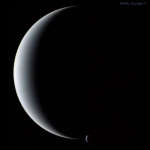 Crescent Neptune and Triton
27.05.2023
Gliding through the outer Solar System, in 1989 the Voyager 2 spacecraft looked toward the Sun to find this view of most distant planet Neptune and its moon Triton together in a crescent phase. The elegant image of ice-giant planet and largest moon was taken from behind just after Voyager's closest approach.
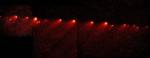 A String Of Pearls
23.03.1997
Comet Shoemaker-Levy 9, named after its co-discoverers, was often referred to as the "string of pearls" comet. It is famous for its unusual appearance as well as its collision with the planet Jupiter!
 Astro 1 In Orbit
20.02.1999
In December of 1990, the Space Shuttle Columbia carried an array of astronomical telescopes high above the Earth's obscuring atmosphere to observe the Universe at ultraviolet and x-ray wavelengths. The telescopes, known...
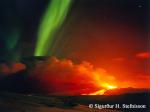 Volcano and Aurora in Iceland
29.01.2006
Sometimes both heaven and Earth erupt. In Iceland in 1991, the volcano Hekla erupted at the same time that auroras were visible overhead. Hekla, one of the most famous volcanoes in the world, has erupted at least 20 times over the past millennium, sometimes causing great destruction.
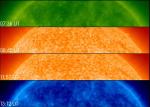 Mercury Spotting
6.06.2004
Can you spot the planet? The diminutive disk of Mercury, the solar system's innermost planet, spent about five hours crossing in front of the enormous solar disk on 2003 May 7, as viewed from the general vicinity of planet Earth.
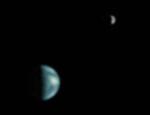 The Earth and Moon from Mars
26.05.2003
What does Earth look like from Mars? The first image of Earth from the red planet was captured earlier this month by the camera onboard the Mars Global Surveyor spacecraft currently orbiting Mars. Features visible on Earth include the Pacific Ocean, clouds, much of South America, and part of North America.
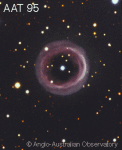 Shapley 1: An Annular Planetary Nebula
12.12.1995
This strange structure is what can result when a normal star runs out of nuclear fuel in its core. At that time, the center condenses into a white dwarf while the outer atmospheric layers are expelled into space and appear as a planetary nebula.
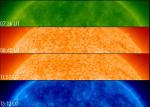 Mercury Spotting
8.05.2003
Can you spot the planet? The diminutive disk of Mercury, the solar system's innermost planet, spent about five hours crossing in front of the enormous solar disk yesterday (Wednesday, May 7th), as viewed from the general vicinity of planet Earth.
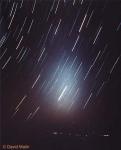 Zodiacal Light
26.08.1997
Sometimes the sky itself seems to glow. Usually, this means you are seeing a cloud reflecting sunlight or moonlight. If the glow appears as a faint band of light running across the whole sky, you are probably seeing the combined light from the billions of stars that compose our Milky Way Galaxy.
|
January February March April May June July August |
||||||||||||||||||||||||||||||||||||||||||||||||||||||||