
|
You entered: comet tail
 APOD: 2024 April 29 Б Comet, Planet, Moon
29.04.2024
Three bright objects satisfied seasoned stargazers of the western sky just after sunset earlier this month. The most familiar was the Moon, seen on the upper left in a crescent phase. The rest of the Moon was faintly visible by sunlight first reflected by the Earth.
 PanSTARRS from France
16.03.2013
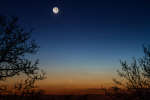
Still looking for that comet? Comet PanSTARRS (C/2011 L4) naked-eye appearance in the northern hemisphere is described by successful comet spotters as a dim star with faint a tail. If you want to catch it the next few days could be your best bet.
 Fairytale NEOWISE
23.07.2020
Comet dust falls through a twilight sky in this dream-like scene, but it's not part of a fairytale movie. Still, Castle Neuschwanstein, nestled in the Bavarian Alps, did inspire Disneyland's Sleeping Beauty Castle. Captured on July 20, the bright streak above the castle towers is likely a Perseid meteor.
 Comet Lovejoy with M44
9.11.2013
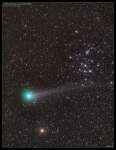
While anxiously waiting for Comet ISON to brighten further as it falls toward the Sun, northern skygazers can also find three other bright comets in the east before dawn. In fact, Comet Lovejoy C/2013 R1 is currently the morning sky's brightest.
 Two Comets in Southern Skies
8.10.2022
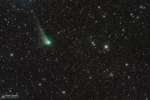
Heading for its closest approach to the Sun or perihelion on December 20, comet C/2017 K2 (PanSTARRS) remains a sight for telescopic observers as it sweeps through planet Earth's southern hemisphere skies. First...
 Comet NEAT and the Beehive Cluster
17.06.2004
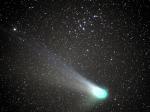
To the unaided eye, they appeared as similar fuzzy patches. But when a bright comet passed in front of a bright star cluster last month, binoculars and cameras were able to show off their marked differences in dramatic fashion.
 Comet LINEAR WM1 Shines in the South
4.02.2002
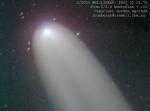
A new comet has brightened unexpectedly and is currently visible to unaided observers of southern skies. Comet C/2000 WM1 (LINEAR) is now reported by some observers to be at third magnitude, making it brighter -- although more diffuse -- than most visible stars. A dust tail as long as 3 degrees has also been reported.
 The Comet, the Whale, and the Hockey Stick
13.05.2021
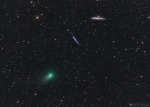
Closest to the Sun on March 1, and closest to planet Earth on April 23, this Comet ATLAS (C/2020 R4) shows a faint greenish coma and short tail in this pretty, telescopic field of view.
 Comet Holmes in Outburst
26.10.2007
Comet 17P/Holmes stunned comet watchers across planet Earth earlier this week. On October 24, it increased in brightness over half a million times in a matter of hours. The outburst transformed it from...
 The View Toward M101
21.01.2016
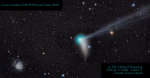
Sweeping through northern skies, Comet Catalina (C/2013 US10) made its closest approach on January 17, passing about 6 light-minutes from our fair planet. Dust and ion tails clearly separated in this Earth-based view, the comet is also posed for a Messier moment, near the line-of-sight to M101, grand spiral galaxy in Ursa Major.
|
January February March April May June July August September |
|||||||||||||||||||||||||||||||||||||||||||||||||