
|
You entered: map
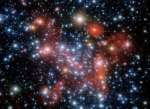 At the Center of the Milky Way
11.12.2008
At the center of our Milky Way Galaxy lies a supermassive black hole. Once a controversial claim, this conclusion is now solidly based on 16 years of observations that map the orbits of 28 stars very near the galactic center.
 APOD: 2024 December 22 Б The Local Fluff
22.12.2024
The stars are not alone. In the disk of our Milky Way Galaxy, about 10 percent of visible matter is in the form of gas called the interstellar medium (ISM). The ISM is not uniform and shows patchiness even near our Sun.
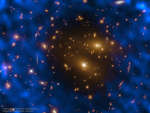 Galaxy Cluster Gas Creates Hole in Microwave Background
10.04.2017
Why would this cluster of galaxy punch a hole in the cosmic microwave background (CMB)? First, the famous CMB was created by cooling gas in the early universe and flies right through most gas and dust in the universe. It is all around us.
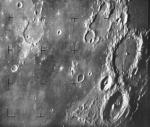 Moon Crashers
15.10.1999
On July 31, 1964, Ranger 7 crashed into the Moon. Seventeen minutes before impact it snapped this picture - the first image of the Moon ever taken by a U.S. spacecraft. Of course Ranger 7 was intended to crash, transmitting close-up pictures of the lunar surface during its final moments.
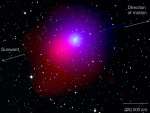 The Swift View of Comet Lulin
21.02.2009
Now growing brighter, Comet Lulin is headed for its closest approach to planet Earth early next week. But the comet's greenish glow, familiar to earthbound skygazers, is replaced by false colors in this premier view from the orbiting Swift satellite.
 LIGO Virgo GW170814 Skymap
28.09.2017
From around planet Earth three gravitational wave detectors have now reported a joint detection of ripples in spacetime, the fourth announced detection of a binary black hole merger in the distant Universe. The event...
 Rotating Asteroid Bennu from OSIRIS REx
13.11.2018
Could this close-by asteroid ever hit the Earth? Eventually yes -- but probably not for a very long time, even though the asteroid is expected to pass inside the orbit of the Moon next century.
 The Matter of the Bullet Cluster
24.08.2006
The matter in galaxy cluster 1E 0657-56, fondly known as the "bullet cluster", is shown in this composite image. A mere 3.4 billion light-years away, the bullet cluster's individual galaxies are seen...
 The Matter of the Bullet Cluster
23.08.2008
The matter in galaxy cluster 1E 0657-56, fondly known as the "bullet cluster", is shown in this composite image. A mere 3.4 billion light-years away, the bullet cluster's individual galaxies are seen...
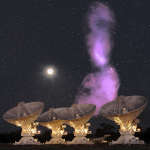 Centaurus Radio Jets Rising
13.04.2011
What if you could see the huge radio jets of Centaurus A rising? The Cen A radio jets are not only over a million light years long, they occupy an angular area over 200 times greater than the full Moon in Earth's sky.
|
January February March April May June July August September |
|||||||||||||||||||||||||||||||||||||||||||||||||