
|
You entered: star formation
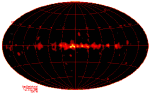 COMPTEL Explores The Radioactive Sky
24.07.1996
Diffuse gas clouds laced with radioactive aluminum atoms (Al26) line the plane of our Milky Way Galaxy! How do we see them? Relying on the Compton Effect, the COMPTEL instrument onboard NASA's immense orbiting Compton Gamma Ray Observatory can "see" the 1.8 million electron Volt gamma rays emitted by the radioactive decay.
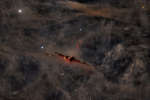 APOD: 2026 July 9 Б The Red Glow of the Cosmic Bat Nebula
8.07.2026
This Cosmic Bat wishes you a happy Summerween! This mid-year celebration of Halloween transcends hemispheres, even though summer in the Northern hemisphere is winter in the South. Contrary to its eery aura, the Cosmic Bat Nebula (LDN 43), not to be confused with the Bat Nebula (NGC 6995), is a vibrant birthplace for stars.
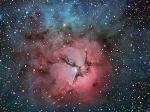 The Trifid Nebula in Stars and Dust
13.08.2007
Unspeakable beauty and unimaginable bedlam can be found together in the Trifid Nebula. Also known as M20, this photogenic nebula is visible with good binoculars towards the constellation of Sagittarius. The energetic processes of star formation create not only the colors but the chaos. The red-glowing gas results from high-energy starlight striking interstellar hydrogen gas.
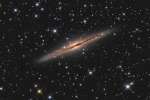 Edge on Spiral Galaxy NGC 891
24.02.2010
This beautiful cosmic portrait features NGC 891. The spiral galaxy spans about 100 thousand light-years and is seen almost exactly edge-on from our perspective. In fact, about 30 million light-years distant in the constellation Andromeda, NGC 891 looks a lot like our Milky Way.
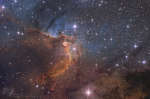 SH2 155: The Cave Nebula
5.11.2014
This colorful skyscape features the dusty Sharpless catalog emission region Sh2-155, the Cave Nebula. In the composite image, data taken through narrowband filters tracks the glow of ionized sulfur, hydrogen, and oxygen atoms in red, green, and blue hues.
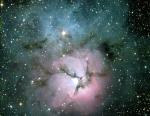 M20: The Trifid Nebula
28.03.2000
Unspeakable beauty and unimaginable bedlam can be found together in the Trifid Nebula. Also known as M20, this photogenic nebula is visible with good binoculars towards the constellation of Sagittarius. The energetic processes of star formation create not only the colors but the chaos. The red-glowing gas results from high-energy starlight striking interstellar hydrogen gas.
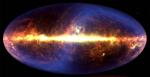 The Infrared Sky
27.01.1998
Three major sources contribute to the far-infrared sky: our Solar System, our Galaxy, and our Universe. The above image, in representative colors, is a projection of the entire infrared sky created from years of observations by the robot spacecraft COBE.
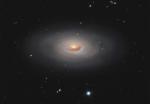 M64: The Black Eye Galaxy
2.08.2007
This bright, beautiful spiral galaxy is Messier 64, sometimes known as the Black Eye Galaxy. M64 lies about 17 million light-years distant in the otherwise well-groomed northern constellation Coma Bernices. The dark clouds along...
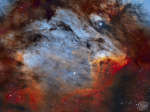 The Pelican Nebula in Gas, Dust, and Stars
24.09.2019
The Pelican Nebula is slowly being transformed. IC 5070, the official designation, is divided from the larger North America Nebula by a molecular cloud filled with dark dust. The Pelican, however, receives much study because it is a particularly active mix of star formation and evolving gas clouds.
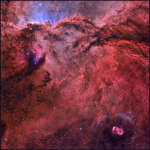 NGC 6188 and NGC 6164
28.12.2012
Fantastic shapes lurk in clouds of glowing hydrogen gas in NGC 6188, about 4,000 light-years away. The emission nebula is found near the edge of a large molecular cloud unseen at visible wavelengths, in the southern constellation Ara.
|
January February March April May June July August September October |
|||||||||||||||||||||||||||||||||||||||||||||||||