
|
You entered: Earth
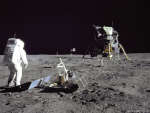 Moonquakes Surprisingly Common
21.07.2019
Why are there so many moonquakes? Analyses of seismometers left on the moon by the Apollo moon landings reveals a surprising number of moonquakes occurring within 100 kilometers of the surface. In fact, 62 moonquakes were detected in data recorded between 1972 and 1977.
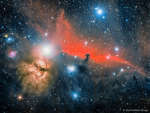 The Horsehead Nebula
6.10.2019
The Horsehead Nebula is one of the most famous nebulae on the sky. It is visible as the dark indentation to the red emission nebula in the center of the above photograph. The horse-head feature is dark because it is really an opaque dust cloud that lies in front of the bright red emission nebula.
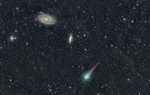 Comet PanSTARRs and the Galaxies
6.06.2020
Comet PanSTARRs, C/2017 T2, shared this stunning telescopic field of view with galaxies M81 and M82 on May 22/23. Of course, the galaxies were some 12 million light-years distant and the comet about 14 light-minutes away, seen in planet Earth's sky toward the Big Dipper.
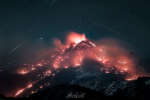 Stars over an Erupting Volcano
3.03.2021
Mt. Etna has been erupting for hundreds of thousands of years. Located in Sicily, Italy, the volcano produces lava fountains over one kilometer high. Mt. Etna is not only one of the most active...
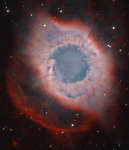 NGC 7293: The Helix Nebula
14.10.2021
A mere seven hundred light years from Earth, toward the constellation Aquarius, a sun-like star is dying. Its last few thousand years have produced the Helix Nebula (NGC 7293), a well studied and nearby example of a Planetary Nebula, typical of this final phase of stellar evolution.
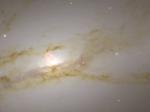 A Bubbling Galaxy Center
12.06.2000
What's happening in the center of this galaxy? Close inspection of the center of NGC 4438, as visible in this recently released representative-color image by the Hubble Space Telescope, reveals an unusual bubble of hot gas, colored in red.
 In Chandor Chasma on Mars
31.05.2002
Scroll right and dive into a spectacular canyon on Mars. This daytime infrared view, recently recorded by the THEMIS camera on board the orbiting Mars Odyssey spacecraft, covers a 30 by 175 kilometer swath running along the canyon floor.
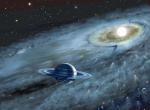 Fomalhaut Dust Disk Indicates Planets
11.10.2002
One of the brightest stars on the sky likely has planets. Fomalhaut, actually the 17th brightest star in the night sky, is a mere 22 light-years away but only a fraction of the age of our Sun.
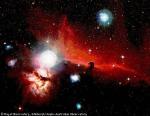 Orion's Horsehead Nebula
25.10.1997
The Horsehead Nebula is one of the most famous nebulae on the sky. It is visible as the black indentation to the red emission nebula seen just to the right of center of the above photograph. The bright star near the center is located in the belt of the familiar constellation of Orion.
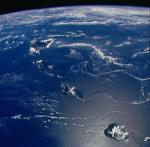 Hawaii
25.07.1998
Aloha! With the graceful arc of the Earth's limb in the background, the Hawaiian Island archipelago is visible in this stunning photo taken by the astronauts onboard the shuttle Discovery in October of 1988. Along with popular beaches and tropical resorts, these volcanic islands offer extreme elevations with dark, dry, cloudless skies.
|
January February March April May June July August September October |
|||||||||||||||||||||||||||||||||||||||||||||||||