
|
You entered: planets
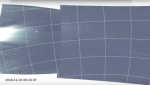 Looking Sideways from the Parker Solar Probe
8.12.2019
Everybody sees the Sun. Nobody's been there. Starting in 2018 though, NASA launched the robotic Parker Solar Probe (PSP) to investigate regions near to the Sun for the first time. The PSP's looping orbit brings it yet closer to the Sun each time around -- every few months.
 Supernova Remnant Cassiopeia A
13.12.2023
Massive stars in our Milky Way Galaxy live spectacular lives. Collapsing from vast cosmic clouds, their nuclear furnaces ignite and create heavy elements in their cores. After only a few million years for the most massive stars, the enriched material is blasted back into interstellar space where star formation can begin anew.
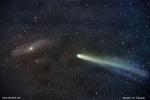 A Galaxy is not a Comet
30.01.2004
This gorgeous galaxy and comet portrait was recorded on April 5th, 2002, in the skies over the Oriental Pyrenees near Figueres, Spain. From a site above 1,100 meters, astrophotographer Juan Carlos Casado used...
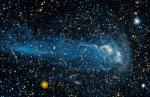 The Tail of a Wonderful Star
17.08.2007
To seventeenth century astronomers, Omicron Ceti or Mira was known as a wonderful star, a star whose brightness could change dramatically in the course of about 11 months. Mira is now seen as the archetype of an entire class of long-period variable stars.
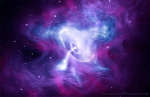 The Spinning Pulsar of the Crab Nebula
20.08.2022
At the core of the Crab Nebula lies a city-sized, magnetized neutron star spinning 30 times a second. Known as the Crab Pulsar, it is the bright spot in the center of the gaseous swirl at the nebula's core.
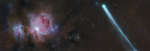 APOD: 2026 May 12 Б The Conjunction of Comet R3 PanSTARRS and the Orion Nebula
11.05.2026
TodayБs composite image features something old, something new, something borrowed, and something blue! Comet R3 PanSTARRS, streaking across the right of the image, likely originated from the Oort Cloud, meaning it is an old Solar System relic from billions of years ago.
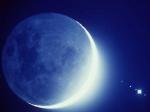 Tonight: A Blue Moon
31.07.2004
How often does a full moon occur twice in a single month? Exactly once in a Blue Moon. In fact, the modern usage of the term "Blue Moon" refers to the second Full Moon in a single month. Tonight's Blue Moon will be the first since November 2001.
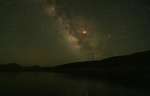 A Total Lunar Eclipse Over Tajikistan
5.10.2014
If the full Moon suddenly faded, what would you see? The answer during the total lunar eclipse of 2011 June was recorded in a dramatic time lapse video from Tajikistan. During a total lunar eclipse, the Earth moves between the Moon and the Sun, causing the moon to fade dramatically.
 Pickering s Triangle in the Veil
16.09.2015
Chaotic in appearance, these filaments of shocked, glowing gas break across planet Earth's sky toward the constellation of Cygnus, as part of the Veil Nebula. The Veil Nebula itself is a large supernova remnant, an expanding cloud born of the death explosion of a massive star.
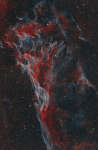 Williamina Fleming s Triangular Wisp
9.11.2017
Chaotic in appearance, these tangled filaments of shocked, glowing gas are spread across planet Earth's sky toward the constellation of Cygnus as part of the Veil Nebula. The Veil Nebula itself is a large supernova remnant, an expanding cloud born of the death explosion of a massive star.
|
January February March April May June July August September October |
|||||||||||||||||||||||||||||||||||||||||||||||||