
|
You entered: planet
 APOD: 2025 August 22 Б A Tale of Two Nebulae
22.08.2025
This colorful telescopic view towards the musical northern constellation Lyra reveals the faint outer halos and brighter central ring-shaped region of M57, popularly known as the Ring Nebula. To modern astronomers M57 is a well-known planetary nebula.
 Around The Arches Cluster
14.06.2001
The most compact cluster of stars known in our galaxy, the Arches cluster, boasts 100 or so massive, young stars contained within a diameter of one light-year. Seen toward the constellation Sagittarius, the Arches...
 NGC 253: Close Up
19.05.2011
This dusty island universe is one of the brightest spiral galaxies in planet Earth's sky. Seen nearly edge-on, NGC 253 is only 13 million light-years away, the largest member of the Sculptor Group of galaxies, neighbor to our own local galaxy group.
 Space Station Lookout
10.04.2013
If you glanced out a side window of the International Space Station, what might you see? If you were Expedition 34 flight engineer Chris Hadfield, and you were looking out one of windows of Japan's Kibo Research Module on February 26, you might have seen the above vista.
 Layers of a Total Solar Eclipse
27.09.2017
Neither rain, nor snow, nor dark of night can keep a space-based spacecraft from watching the Sun. In fact, from its vantage point 1.5 million kilometers sunward of planet Earth, NASA's SOlar Heliospheric Observatory (SOHO) can always monitor the Sun's outer atmosphere, or corona.
 APOD: 2025 August 9 Б Interstellar Interloper 3I/ATLAS from Hubble
9.08.2025
Discovered on July 1 with the NASA-funded ATLAS (Asteroid Terrestrial-impact Last Alert System) survey telescope in Rio Hurtado, Chile, 3I/ATLAS is so designated as the third known interstellar object to pass through our Solar System. It follows 1I/йOumuamua in 2017 and the comet 2I/Borisov in 2019.
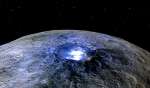 The Brightest Spot on Ceres
11.12.2015
Dwarf planet Ceres is the largest object in the Solar System's main asteroid belt with a diameter of about 950 kilometers. Exploring Ceres from orbit since March, the Dawn spacecraft's camera...
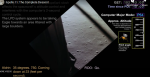 Apollo 11: Descent to the Moon
17.07.2019
It had never been done before. But with the words "You're Go for landing", 50 years ago this Saturday, Apollo 11 astronauts Aldrin and Armstrong were cleared to make the first try.
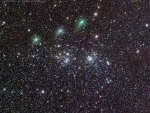 Two Custers and a Comet
30.01.2020
This lovely starfield spans some four full moons (about 2 degrees) across the heroic northern constellation of Perseus. In telescopic exposures made during the nights of January 24, 26, and 28 it holds...
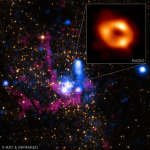 The Milky Way s Black Hole
13.05.2022
There's a black hole at the center of the Milky Way. Stars are observed to orbit a very massive and compact object there known as Sgr A* (say "sadge-ay-star"). But this just released...
|
January February March April May June July August September October |
|||||||||||||||||||||||||||||||||||||||||||||||||