
|
You entered: Deep Sky
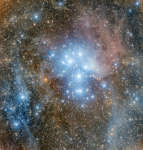 Messier 45: The Daughters of Atlas and Pleione
7.11.2019
Hurtling through a cosmic dust cloud a mere 400 light-years away, the lovely Pleiades or Seven Sisters open star cluster is well-known for its striking blue reflection nebulae. It lies in the night sky toward the constellation Taurus and the Orion Arm of our Milky Way Galaxy.
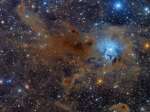 NGC 7023: The Iris Nebula
6.05.2016
These cosmic clouds have blossomed 1,300 light-years away, in the fertile starfields of the constellation Cepheus. Called the Iris Nebula, NGC 7023 is not the only nebula to evoke the imagery of flowers, though.
 Milky Way Rising
1.12.2023
The core of the Milky Way is rising beyond the Chilean mountain-top La Silla Observatory in this deep night skyscape. Seen toward the constellation Sagittarius, our home galaxy's center is flanked...
 APOD: 2024 January 29 Б The Pleiades: Seven Dusty Sisters
29.01.2024
The well-known Pleiades star cluster is slowly destroying part of a passing cloud of gas and dust. The Pleiades is the brightest open cluster of stars on Earth's sky and can be seen from almost any northerly location with the unaided eye.
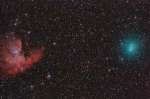 Pacman and Hartley
7.10.2010
Touring the solar system with a 6 year orbital period, small comet Hartley 2 (103/P Hartley) will make its closest approach to planet Earth on October 20 and its closest approach to the Sun on October 28. It may become a naked-eye comet, just visible in clear, dark skies.
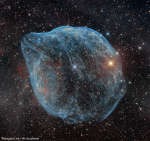 Sharpless 308: The Dolphin-Head Nebula
21.10.2021
Blown by fast winds from a hot, massive star, this cosmic bubble is huge. Cataloged as Sharpless 2-308 it lies some 5,000 light-years away toward the constellation of the Big Dog (Canis Major) and covers slightly more of the sky than a Full Moon.
 Juno Mission Trailer
28.06.2016
What will NASA's Juno spacecraft find when it reaches Jupiter next Monday? Very little, if Juno does not survive Jupiter Orbit Insertion, a complex series of operations in an unknown environment just above Jupiter's cloud tops.
 Sharpless 308: The Dolphin Head Nebula
7.06.2024
Blown by fast winds from a hot, massive star, this cosmic bubble is huge. Cataloged as Sharpless 2-308 it lies some 5,000 light-years away toward the well-trained constellation Canis Major and covers slightly more of the sky than a Full Moon. That corresponds to a diameter of 60 light-years at its estimated distance.
 La Superba
18.12.2008
Y Canum Venaticorum (Y CVn) is a very rare star in planet Earth's night sky. It's also very red, exhibiting such a remarkable spectrum of light, 19th century astronomer Angelo Secchi dubbed it La Superba.
 Cygnus X: The Inner Workings of a Nearby Star Factory
18.01.2012
How do stars form? To help study this complex issue, astronomers took a deep infrared image of Cygnus X, the largest known star forming region in the entire Milky Way Galaxy. The above recently-released...
|
January February March April May June July August September |
|||||||||||||||||||||||||||||||||||||||||||||||||