
|
You entered: Earth's moon
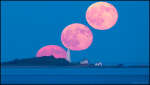 Full Moon and Boston Light
13.07.2017
This well-planned telephoto timelapse captures July's Full Moon rise across outer Boston Harbor, Massachusetts, planet Earth. In the foreground, the historic terrestrial beacon is known as Boston Light. July's Full Moon...
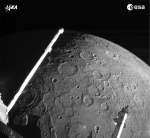 Mercury from Passing BepiColombo
28.06.2022
Which part of the Moon is this? No part -- because this is the planet Mercury. Mercury's old surface is heavily cratered like that of Earth's Moon. Mercury, while only slightly larger than Luna, is much denser and more massive than any Solar System moon because it is made mostly of iron.
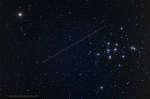 Close Encounter with M44
28.01.2015
On Monday, January 26, well-tracked asteroid 2004 BL86 made its closest approach, a mere 1.2 million kilometers from our fair planet. That's about 3.1 times the Earth-Moon distance or 4 light-seconds away. Moving...
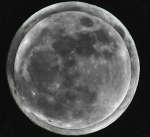 Micro Moon over Super Moon
21.01.2014
Did you see the big, bright, beautiful Full Moon last Wednesday night? That was actually a Micro Moon! On that night, the smallest Full Moon of 2014 reached its full phase only a few hours from lunar apogee, the time of its the most distant point from Earth in the Moon's elliptical orbit.
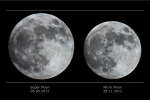 Super Moon vs Micro Moon
29.11.2012
Did you see the big, bright, beautiful Full Moon Wednesday night? That was actually a Micro Moon! On that night, the smallest Full Moon of 2012 reached its full phase only about 4 hours before apogee, the most distant point from Earth in the Moon's elliptical orbit.
 Moons Near Jupiter
23.05.2019
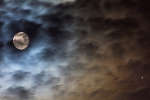
On May 20, a nearly Full Moon and Jupiter shared this telephoto field of view. Captured when a passing cloud bank dimmed the moonlight, the single exposure reveals the familiar face of our fair planet's own large natural satellite, along with bright Jupiter (lower right) and some of its Galilean moons.
 APOD: 2007 August 1- Unusual Cratering on Saturns Dione
1.08.2007
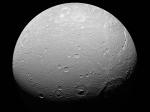
Why does one half of Dione have more craters than the other? Start with the fact that Saturn's moon Dione always has one side that faces Saturn, and always has one side that faces away. This is similar to Earth's Moon.
 Eclipsed Moon and Stars
23.05.2003
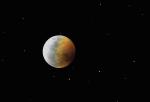
Half-shadowed by the Earth, the Moon takes on a remarkable appearance against a field of stars in this intriguing telephoto picture recorded during a partial phase of last week's lunar eclipse. The picture is not a composite, but it has been digitally enhanced to bring out features covering a large range in brightness.
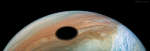 Io Eclipse Shadow on Jupiter from Juno
7.10.2019
What's that dark spot on Jupiter? It's the shadow of Jupiter's most volcanic moon Io. Since Jupiter shines predominantly by reflected sunlight, anything that blocks that light leaves a shadow. If you could somehow be in that shadow, you would see a total eclipse of the Sun by Io.
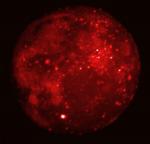 Eclipsed Moon in Infrared
10.01.1997
Last September's total lunar eclipse disappointed many observers in the Eastern and Midwestern US who were cursed with cloudy skies. However, the Midcourse Space Experiment (MSX) satellite had a spectacular view from Earth orbit and SPIRIT III, an onboard imaging infrared telescope, was used to repeatedly image the moon during the eclipse.
|
January February March April May June July August September |
|||||||||||||||||||||||||||||||||||||||||||||||||