
|
You entered: Milky Way
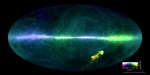 HI4PI: The Hydrogen Sky
24.10.2016
Where are the Milky Way's gas clouds and where are they going? To help answer this question, a new highest-resolution map of the sky in the universe's most abundant gas -- hydrogen -- has been completed and recently released, along with its underlying data.
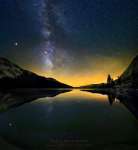 Six Planets from Yosemite
14.06.2018
The five naked-eye planets, Mercury, Venus, Mars, Jupiter and Saturn, have been seen since ancient times to wander the night skies of planet Earth. So it could be remarkable that on this night, standing at the side of a clear, calm lake, six planets can be seen with the unaided eye. Have a look.
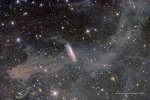 Galaxy, Stars, and Dust
12.10.2015
Is this galaxy trapped in a web of dust? No -- it is far in the background. However, spiky stars and spooky shapes are abound in this deep cosmic skyscape. Its well-composed field of view covers about a Full Moon on the sky toward the constellation Pegasus.
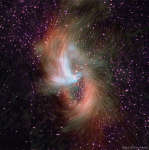 Our Galaxys Magnetic Center
19.06.2019
What's the magnetic field like in the center of our Milky Way Galaxy? To help find out, NASA's SOFIA -- an observatory flying in a modified 747 -- imaged the central region with...
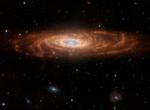 NGC 7331: A Galaxy So Inclined
1.07.2004
If our own Milky Way galaxy were 50 million light-years away with its disk inclined slightly to our line of sight, it would look a lot like large spiral galaxy NGC 7331. In fact...
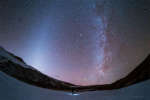 Dueling Bands in the Night
1.03.2022
What are these two bands in the sky? The more commonly seen band is the one on the right and is the central band of our Milky Way galaxy. Our Sun orbits...
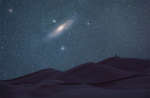 Andromeda over the Sahara Desert
11.07.2022
What is the oldest thing you can see? At 2.5 million light years distant, the answer for the unaided eye is the Andromeda galaxy, because its photons are 2.5 million years old when they reach you.
 M31 versus M33
26.09.2013
Separated by about 14 degrees (28 Full Moons) in planet Earth's sky, spiral galaxies M31 ,left, and M33 are both large members of the Local Group, along with our own Milky Way galaxy.
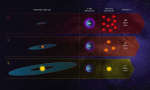 Goldilocks Zones and Stars
31.01.2020
The Goldilocks zone is the habitable zone around a star where it's not too hot and not too cold for liquid water to exist on the surface of orbiting planets. This intriguing infographic...
 Canaries Sky
10.04.1999
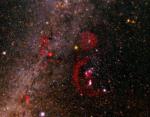
This gorgeous view of stars, nebulae, and the Milky Way comes from the dark night sky above the lovely island of La Palma in the Canaries archipelago. The picture was made by a group...
|
January February March April May June July August September October |
|||||||||||||||||||||||||||||||||||||||||||||||||