
|
You entered: Solar System
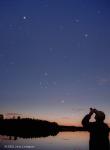 Dusk of the Planets
29.04.2002
A great grouping of planets is now visible to the west just after sunset. Over the next two weeks, Mercury, Venus, Earth, Mars, Jupiter, and Saturn -- all the planets of the inner Solar System -- can be seen in a single knowing glance. The image on the left captured them all in one frame.
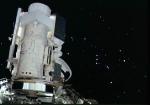 Astro 1 In Orbit
17.08.1997
In December of 1990, the Space Shuttle Columbia carried an array of astronomical telescopes high above the Earth's obscuring atmosphere to observe the Universe at ultraviolet and x-ray wavelengths. The telescopes, known...
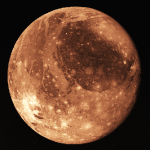 Ganymede: Moonquake World
4.09.1995
Ganymede probably undergoes frequent ground shaking events not unlike terrestrial earthquakes. Ganymede, the largest moon of Jupiter and the Solar System, has a thick outer coating of water ice. Passing Voyager spacecraft found...
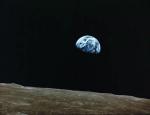 The Millennium that Defined Earth
31.12.1999
When the second millennium began, people generally knew that the Earth was round, but few saw much of it beyond their local village. As the millennium progressed, humans mapped the continents, circumnavigated the globe, and determined the composition of the Earth.
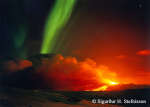 Volcano and Aurora in Iceland
8.07.2012
Sometimes both heaven and Earth erupt. In Iceland in 1991, the volcano Hekla erupted at the same time that auroras were visible overhead. Hekla, one of the most famous volcanoes in the world, has erupted at least 20 times over the past millennium, sometimes causing great destruction.
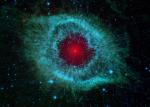 APOD: 2007 February 23- Dust and the Helix Nebula
23.02.2007
Dust makes this cosmic eye look red. The eerie Spitzer Space Telescope image shows infrared radiation from the well-studied Helix Nebula (NGC 7293) a mere 700 light-years away in the constellation Aquarius.
 Dust and the Helix Nebula
31.12.2009
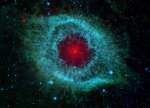
Dust makes this cosmic eye look red. The eerie Spitzer Space Telescope image shows infrared radiation from the well-studied Helix Nebula (NGC 7293) a mere 700 light-years away in the constellation Aquarius.
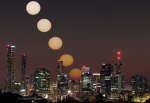 Spotty Sunrise over Brisbane
11.07.2014
In this composite cityscape, dawn's first colors backdrop the lights along Brisbane's skyline at the southeastern corner of Queensland, Australia, planet Earth. Using a solar filter, additional exposures made every 3.5 minutes follow the winter sunrise on July 8 as planet-sized sunspots cross the visible solar disk.
 A Solar Corona Ejection
8.11.1996
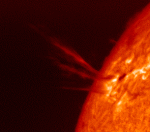
The Sun would not be a nice place to spend the summer. One reason, besides the extreme heat, is that explosions are common there. In the above picture, magnetic fields buckle releasing previously constrained hot material from the upper atmosphere of the Sun.
 The Night Side of Saturn
5.07.1995
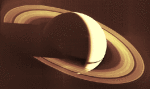
This image of Saturn was made in November 1980 by the Voyager 1 spacecraft as it flew past the ringed gas giant planet. From a spectacular vantage point, looking back toward the inner solar system, the robot spacecraft recorded this view of the night side of Saturn casting a sharp shadow across the bright rings.
|
January February March April May June July August |
||||||||||||||||||||||||||||||||||||||||||||||||||||||||