
|
You entered: TRACE
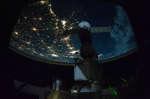 Night Lights
3.11.2010
Constellations of lights sprawl across this night scene, but they don't belong in the skies of planet Earth. Instead, the view looks down from the International Space Station as it passed over the United States along the northern Gulf Coast on October 29. A Russian Soyuz spacecraft is docked in the foreground.
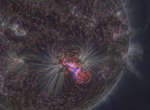 Solar Flare from a Sharper Sun
21.11.2014
Solar active region AR2192 was the largest recorded sunspot group of the last 24 years. Before rotating off the Earth-facing side of the Sun at the end of October, it produced a whopping six energetic X-class flares.
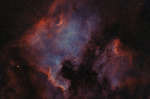 North America and the Pelican
7.09.2022
Fans of our fair planet might recognize the outlines of these cosmic clouds. On the left, bright emission outlined by dark, obscuring dust lanes seems to trace a continental shape, lending the popular name North America Nebula to the emission region cataloged as NGC 7000.
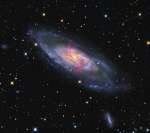 Messier 106
18.03.2011
Close to the Great Bear (Ursa Major) and surrounded by the stars of the Hunting Dogs (Canes Venatici), this celestial wonder was discovered in 1781 by the metric French astronomer Pierre Mechain. Later, it was added to the catalog of his friend and colleague Charles Messier as M106.
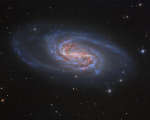 NGC 2903: A Missing Jewel in Leo
9.04.2015
Barred spiral galaxy NGC 2903 is only some 20 million light-years distant. Popular among amateur astronomers, it shines in the northern spring constellation Leo, near the top of the lion's head. That part of the constellation is sometimes seen as a reversed question mark or sickle.
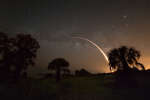 Falcon 9 and Milky Way
13.05.2016
On May 6, the after midnight launch of a SpaceX Falcon 9 rocket lit up dark skies over Merritt Island, planet Earth. Its second stage bound for Earth orbit, the rocket's arc seems to be on course for the center of the Milky Way in this pleasing composite image looking toward the southeast.
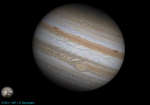 Jupiter Rotates
25.10.2021
Observe the graceful twirl of our Solar System's largest planet. Many interesting features of Jupiter's enigmatic atmosphere, including dark belts and light zones, can be followed in detail. A careful inspection will reveal that different cloud layers rotate at slightly different speeds.
 APOD: 2023 October 3 Б MyCn 18: The Engraved Hourglass Planetary Nebula
2.10.2023
Do you see the hourglass shape -- or does it see you? If you can picture it, the rings of MyCn 18 trace the outline of an hourglass -- although one with an unusual eye in its center. Either way, the sands of time are running out for the central star of this hourglass-shaped planetary nebula.
 APOD: 2023 December 5 Б Energetic Particle Strikes the Earth
4.12.2023
It was one of the most energetic particles ever known to strike the Earth -- but where did it come from? Dubbed Amaterasu after the Shinto sun goddess, this particle, as do all cosmic rays...
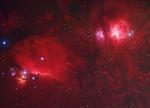 An Orion Deep Field
14.01.2004
Adrift 1,500 light-years away in one of the night sky's most recognizable constellations, the glowing Orion Nebula and the dark Horsehead Nebula are contrasting cosmic vistas. They both appear in this stunning composite digital image assembled from over 20 hours of data that includes exposures filtered to record emission from hydrogen atoms.
|
January February March April May June July August September October |
|||||||||||||||||||||||||||||||||||||||||||||||||