
|
You entered: Venus
 APOD: 2025 August 15 Б Moonlight, Planets, and Perseids
15.08.2025
In the predawn sky on August 13, two planets were close. And despite the glare of a waning gibbous Moon, bright Jupiter and even brighter Venus were hard to miss. Their brilliant close conjunction is poised above the eastern horizon in this early morning skyscape.
 Conjunction by the Sea
26.06.2014
Early morning risers were treated to a beautiful conjunction of Venus and waning Crescent Moon on June 24, captured in this seaside photo near Belmar, New Jersey, USA, planet Earth. The serene celestial pairing is seen above the Atlantic Ocean horizon as the eastern sky grows brighter with dawn's early light.
 APOD: 2025 July 23 Б Fireball over Cape San Blas
23.07.2025
Have you ever seen a fireball? In astronomy, a fireball is a very bright meteor -- one at least as bright as Venus and possibly brighter than even a full Moon. Fireballs are rare -- if you see one you are likely to remember it for your whole life.
 Conjunction of Four
4.02.2017
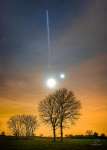
On January 31, a waxing crescent Moon, brilliant Venus, and fainter Mars gathered in the fading twilight, hanging above the western horizon just after sunset on planet Earth. In this combined evening skyscape, the lovely celestial triangle is seen through clouds and haze.
 Comet Leonards Long Tail
3.01.2022
You couldn't see Comet LeonardБs extremely long tail with a telescope Б it was just too long. You also couldn't see it with binoculars Б still too long. Or with your eyes -- it was too dim. Or from a city Б the sky was too bright.
 A Martian Halloween
31.10.2005
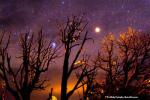
From sunset to sunrise, an unusually bright yellowish orb will hang in the sky this Halloween: Mars. Yesterday, Earth passed Mars as they orbited the Sun, bringing Mars closer than it will be for the next thirteen years. Tonight though, Mars will be nearly as bright as last night, a beacon of extraterrestrial spookiness.
 All Sky Moon Shadow
27.04.2024
If the Sun is up but the sky is dark and the horizon is bright all around, you might be standing in the Moon's shadow during a total eclipse of the Sun. In fact, the all-sky Moon shadow shown in this composited panoramic view was captured from a farm near Shirley, Arkansas, planet Earth.
 Light at the End of the Road
1.09.2016
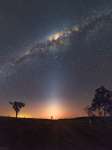
The bright light at the end of this country road is actually a remarkably close conjunction of two planets. After sunset on August 27 brilliant Venus and Jupiter almost appear as a single celestial beacon in the night skyscape taken near Lake Wivenhoe, Queensland, Australia.
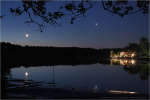 Moon in the Mullica
28.05.2009
Still waters mimic a predawn sky along the eastern horizon in this peaceful scene. The picture was recorded on May 22nd from the banks of the Mullica River, in a forested region known as the Pine Barrens of southern New Jersey on the US east coast.
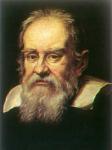 Galileo Demonstrates the Telescope
14.10.2001
Galileo Galilei made a good discovery great. Upon hearing at age 40 that a Dutch optician had invented a glass that made distant objects appear larger, Galileo crafted his own telescope and turned it toward the sky.
|
January February March April May June July August September October |
|||||||||||||||||||||||||||||||||||||||||||||||||