
|
You entered: black hole
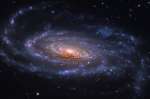 Spiral Galaxy NGC 5033
17.08.2012
Magnificent island universe NGC 5033 lies some 40 million light-years away in the well-trained northern constellation Canes Venatici. This telescopic portrait reveals striking details of dust lanes winding near the galaxy's bright core and majestic but relatively faint spiral arms.
 At the Core of M15
20.11.1995
Densely packed stars in the core of the globular cluster M15 are shown in this Hubble Space Telescope (HST) image taken in April of 1994. The stars revealed are contained in an area 1.6 light years across and their colors roughly indicate their temperatures - hot stars appear blue, cooler stars look reddish-orange.
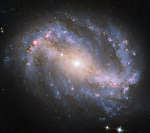 Barred Spiral Galaxy NGC 6217
28.12.2009
Many spiral galaxies have bars across their centers. Even our own Milky Way Galaxy is thought to have a modest central bar. Prominently barred spiral galaxy NGC 6217, pictured above, was captured in spectacular detail in this recently released image taken by the newly repaired Advanced Camera for Surveys on the orbiting Hubble Space Telescope.
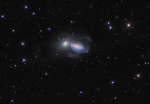 Arp 94
9.10.2013
This telescopic snapshot records a cosmic moment in the tumultuous lives of large spiral galaxy NGC 3227 and smaller elliptical NGC 3226. Catching them in the middle of an ongoing gravitational dance, the sensitive imaging also follows faint tidal star streams flung from the galaxies in their repeated close encounters.
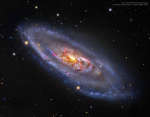 M106: A Spiral Galaxy with a Strange Center
17.03.2019
What's happening at the center of spiral galaxy M106? A swirling disk of stars and gas, M106's appearance is dominated by blue spiral arms and red dust lanes near the nucleus, as shown in the featured image.
 The Large and Small of M87
16.02.1999
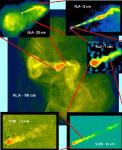
The small core of elliptical galaxy M87 appears to be energizing its whole galactic neighborhood. Recent images from the Very Large Array (VLA) of radio telescopes indicate that huge bubbles of hot gas not only exist but are still being created. These bubbles measure 200,000 light-years across and surround the entire galaxy.
 APOD: 2026 March 21 Б Galaxies in the River: NGC 1300 and NGC 1297
21.03.2026
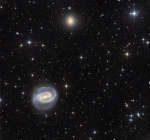
Spiral NGC 1300 and elliptical NGC 1297 are galaxies that lie on the banks of the southern constellation Eridanus (The River). At 70 million light-years distant or more, both are members of the Eridanus Galaxy Cluster.
 Centaurus A
19.11.2015
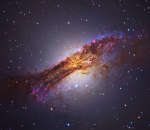
What's the closest active galaxy to planet Earth? That would be Centaurus A, only 11 million light-years distant. Spanning over 60,000 light-years, the peculiar elliptical galaxy is also known as NGC 5128.
 The Galaxy Within Centaurus A
4.03.2006
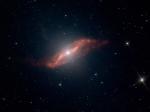
Peering deep inside Centaurus A, the closest active galaxy to Earth, the Spitzer Space Telescope's penetrating infrared cameras recorded this startling vista in February 2004. About 1,000 light-years across, the twisted cosmic...
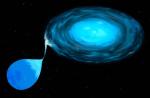 Accretion Disk Binary System
19.12.1999
Our Sun is unusual in that it is alone - most stars occur in multiple or binary systems. In a binary system, the higher mass star will evolve faster and will eventually become a compact object - either a white dwarf star, a neutron star, or black hole.
|
January February March April May June July August September October |
|||||||||||||||||||||||||||||||||||||||||||||||||